skip to main |
skip to sidebar
Some weeks ago we published a post comparing cuts in fire trucks (and in fire-fighting in general) and the purchase of 772 military trucks by the Spanish army, for which the Spanish government paid 149 million euros (VAT not included). It seems that the economical crisis is not affecting the Spanish Ministry of Defense, and the purchase of military trucks is not an isolated example.
Recently, the Cabinet of Spain approved an extraordinary credit of 1,782 million euros for arms. This means increasing the Defense budget by 28.21%. Social services suffer major cuts, but the army budget is still growing.
Another example of wasting money in the Spanish army is the purchase of military helicopters NH90 announced by the Spanish Government. The initial order, submitted in 2006, was 45 helicopters, and the current order is 38. Some days ago the Spanish King flew one of these helicopters as a grand debut in the Spanish society.
Every helicopter costs 25 million euros, so this purchase means 950 million euros wasted in useless means of transport for Spanish citizens. And meanwhile, due to the economical crisis, the Spanish government makes major cuts in civil helicopters, to the point that in Andalusia and the Balearic Islands there is no helicopter for mountain rescue. The reason: there is not money left.
Sources:
Post at Delivering data about the purchase of military trucks:
http://www.deliveringdata.com/2012/08/trucks-versus-trucks.html
Extraordinary credit of 1,782 million euros:
http://thefreeonline.wordpress.com/2012/09/14/bankrupt-spain-defense-budget-increased-by-30/
NH90 helicopter: http://en.wikipedia.org/wiki/NHIndustries_NH90
The Spanish King wants to check the new helicopter:
https://www.eurocopter.com/site/en/press/King-Juan-Carlos-I-Takes-to-the-Air-in-the-Spanish-NH90-Helicopter_970.html?iframe=true&width=700
Cuts in rescue helicopters: http://desnivel.com/escalada-roca/retiran-los-helicopteros-de-rescate-de-bomberos-en-andalucia-y-mallorca-y-mas-problemas-en-alicante

Some areas in our planet are richer in biodiversity than others. Those areas with a higher density of different species are not necessarily where the environment is best protected –it is rather thanks to the type of ecosystem. Tropical rainforests are the top biodiversity-rich ecosystems: only the Amazon rainforest harbours one out of every ten known species of our planet.
Therefore, some countries have a major responsibility to protect this diversity, so the World Conservation Monitoring Centre of the UN Environment Programme (UNEP-WCMC) has been working on this issue since 1988. Up to now, it has identified 17 megadiverse countries, that is, those countries with the highest number of endemic species –at least 5,000 endemic plants.
The world’s top biodiversity-rich continent is America, with 7 megadiverse countries:
- Brazil
- Colombia
- Ecuador
- Unites States
- Mexico
- Peru
- Venezuela
Asia ranks the second, with 5 megadiverse countries:
- The Philippines
- India
- Indonesia
- Malaysia
- China
Africa ranks number three, with 3 megadiverse countries:
- Madagascar
- Democratic Republic of the Congo
- Republic of South Africa
Oceania ranks number 4, with 2 megadiverse countries:
- Australia
- Papua New Guinea
Europe has no megadiverse country.
Sources:
- Biodiversity: http://en.wikipedia.org/wiki/Biodiversity
- Biodiversity in the Amazon rainforest: http://wwf.panda.org/what_we_do/where_we_work/amazon/
- World Conservation Monitoring Centre of the UN Environment Programme: http://www.unep-wcmc.org/
- Megadiversity countries: http://www.biodiversitya-z.org/areas/26
- Endemic species: http://en.wikipedia.org/wiki/Endemism

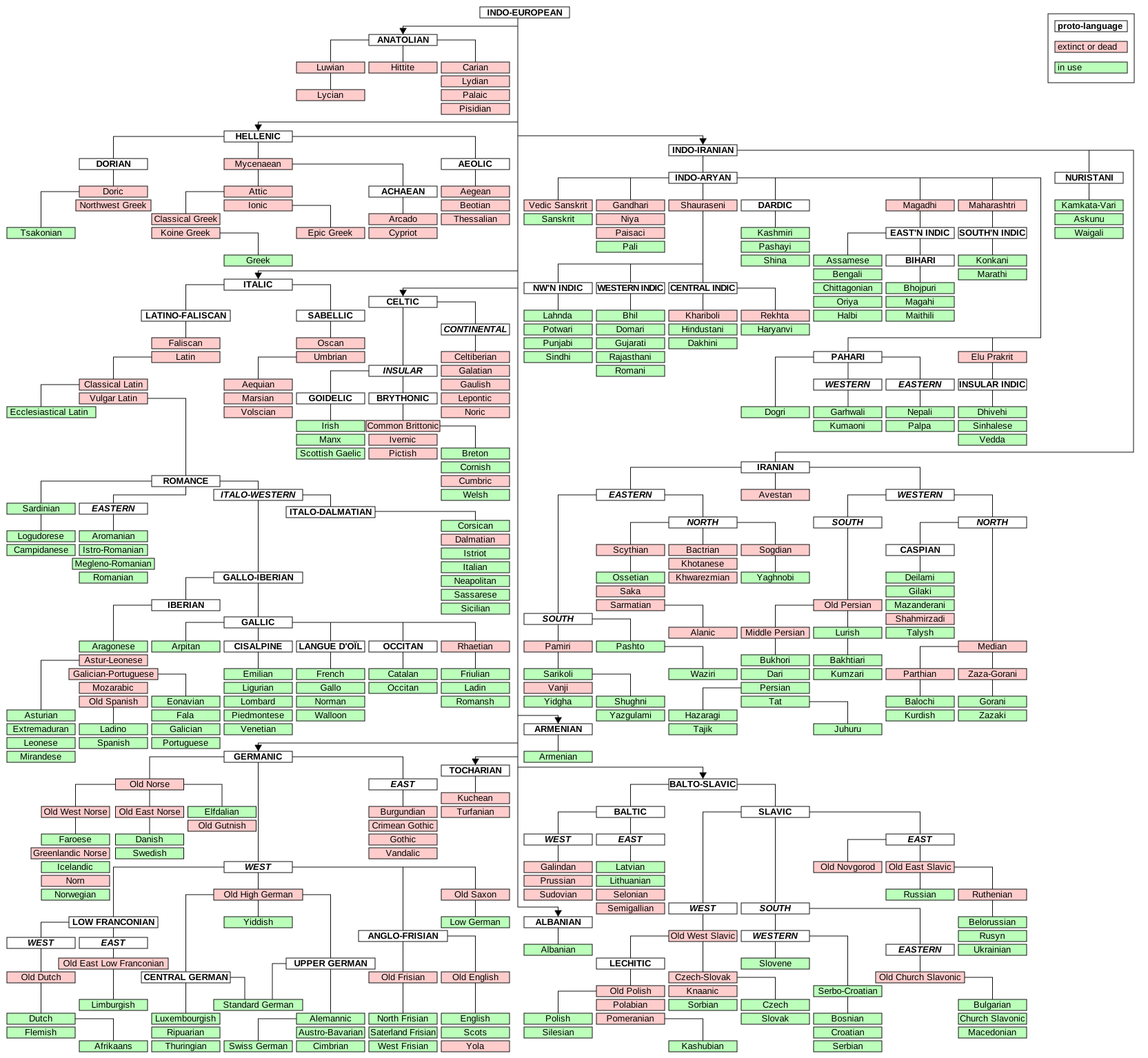
English is an Indo-European language like French, Persian, Urdu, Catalan, Russian, Greek or Bengali. It is the most largely-spoken language family in our world: half the inhabitants of our planet speak one Indo-European language. But out of the current 7,000 living languages in the world, only 6.5% (about 450 languages) belong to this family. Therefore, it is a family with few languages but many speakers.
On the island of New Guinea we find the opposite situation: there are many languages but few speakers. It is the world’s area with the richest language diversity by far, although it has less than 8 million inhabitants.
New Guinea is the world’s second largest island after Greenland (Australia is considered to be a continent), covering a land area of 786,000 km2 (more or less like Turkey or one and a half Spain). The western part belongs to Indonesia whereas the eastern part is an independent state since 1975: Papua New Guinea.
According to Ethnologue: Languages of the World, one of the main references in this field, a total of 1,073 languages are spoken on this island: 826 in Papua New Guinea and 257 in the western part of the island. These figures represent more than 15% of the 6,909 living languages recorded by this encyclopaedic catalogue in the whole world. Most of these languages belong to the Austronesian group and the Papuan group, which are the world’s second and third families with most languages after the Niger-Congo language family.
In Spain we have less than a dozen autochthonous languages, and only five of them are considered to be co-official. However, there are still many Spaniards who consider that such “language diversity” may pose some problems. What may New Guineans think of a country like Spain?
Sources:
- Indo-European languages: http://upload.wikimedia.org/wikipedia/commons/4/4f/IndoEuropeanTree.svg
- New Guinea island: http://goo.gl/maps/TaC0h
- List of countries by area: http://en.wikipedia.org/wiki/List_of_countries_and_dependencies_by_area
- Indonesia: http://en.wikipedia.org/wiki/Indonesia
- Papua New Guinea: http://en.wikipedia.org/wiki/Papua_New_Guinea
- Ethnologue: Languages of the World web site: http://www.ethnologue.com/
- Austronesian languages: http://en.wikipedia.org/wiki/Austronesian_languages
- Papuan languages: http://en.wikipedia.org/wiki/Papuan_languages
- Languages of Spain: http://en.wikipedia.org/wiki/Languages_of_Spain





 Posts
Posts