skip to main |
skip to sidebar

According to UNICEF, there are more than 100 million street children in the world, and this number has not varied for more than 20 years. “Street children” is a term used to refer to homeless children under 18 years old deprived of family care and protection. In Latin America, the continent where most street children are to be found, there are 40 millions. UNICEF estimates that more than 50% of these 40 million boys and girls living on the streets in Latin America sniff industrial glue, which is the only drug they can afford. They are the clients of a business raising huge amounts of money: 77 million litres of glue are consumed every month.
Figures are appalling, but it gets even more serious if we realise what 20 million children represents. In Spain, there are 8 million children in total (to be precise, 8,290,639 children according to the 2010 census); in France, there are 13 million children (13,662,000 in 2008 according to UNICEF). Therefore, it is as if all children living in France and Spain, including babies and up to 17-year-old teenagers, were inhaling industrial glue.
Sources
- UNICEF: http://www.unicef.org
- Consortium for Street Children website, an international network working to promote street children’s rights: http://www.streetchildren.org.uk
- Spanish National Statistics Institute: http://www.ine.es/en/welcome_en.htm
- Statistics in France: http://www.unicef.org/infobycountry/france_statistics.html
It is obvious that drinking tap water (or spring water, if we are lucky) is far better than drinking bottled water, at least for environmental issues, but why is it so? And to what extent? In order to give a good answer to this question, we should take a look at the P-issues: Price, Plastic, Postage-and-Packing and Product Prodigality (a little bit Phar-Phetched, I know). Also, some people claim that bottled water may be somewhat harmful for our health, but none of their arguments seems quite convincing to me… and it is not a P-issue anyway.
Price. Bottled water is more expensive, even 10,000 times more expensive than tap water. It is difficult to make an estimate because there are many bottled water brands with different prices, and tap water price also varies depending on the country and the household consumption. Just to get an idea, I took my latest water bill and a calculator, and I realised that I pay 0.0004657 € per litre of water. In other words, with 1 € I pay 2,147 litres of water. Now you can check the price of any bottled water: it is way too expensive.
Plastic. This tremendous increase in price is not only due to trading benefits: putting water into bottles is also expensive. But the problem is not the price of bottles, but the amount of plastic and glass required. Every year we waste 17 million barrels of crude oil to manufacture plastic bottles, which is the necessary amount of oil required to move one million cars every year. Moreover, only one out of every five plastic bottles is recycled.
Postage and packing. The environmental impact and the waste of oil and money increases if we take into account freight costs: oil should be taken from oil wells to factories to manufacture bottles, then these bottles should be taken to bottling plants and, once filled, they are taken to the grocer’s and eventually, from the store to our house. A bottle drunk in Barcelona may have been manufactured with oil from the Persian Gulf or from Brazil in a factory located in Southeast Asia, filled with water in the Pyrenees or Sierra Nevada and then shipped to Barcelona for our consumption.
Product Prodigality. The bottling process results in water wasting. From 3 to 5 litres of source water from the aquifer are wasted in every bottled litre. Some more water is also wasted in the plastic manufacturing process, in the oil extraction, in the steel manufacturing process later used in trucks and boats, in the bottle recycling process… It is impossible to make an accurate calculation because there are too many variables, but just bear in mind one fact: the steel used to manufacture just one car requires the consumption of 177,000 litres of water (that is 39,000 gallons of water).
Most water consumed by humans is not for drinking purposes but for construction, irrigation and cattle fattening. However, it does not mean that drinking water has no impact on our planet… and if we drink bottled water, this impact is even greater. One final note: every year 200,000 million litres of bottled water are consumed around the world (5,500 millions just in Spain). Therefore, our option is clear: we should drink draught beer and tap water (filtered, if you want), but if you insist on buying bottled water, at least take big bottles so that you waste less plastic.
Sources:
There are many web sites with data about bottled water –some of them more serious than some others. Just to give you an idea:
- http://www.bottledwaterblues.com/bottled_water_facts.php
- http://www.techeblog.com/index.php/tech-gadget/bottled-water-facts
- http://www.gisngeo.com/water/en.php
- Post at Delivering Data about bottled beer: http://www.deliveringdata.com/2011/01/draught-beer-or-bottled-beer.html

Some weeks ago, Greenpeace carried out a campaign in China to raise awareness against disposable chopsticks, in favour of those which can be used more than once. Is it an overreaction? Definitely not, if we take a look at the figures.
Only in China, 57,000 million pairs of disposable wooden chopsticks were manufactured in 2009. Taking into account that China has a population of 1,300 million inhabitants, it means that each inhabitant disposes 43 pairs of chopsticks every year as average, resulting in two pairs every week. These figures account for many chopsticks and too much wood to manufacture them: to be precise, 3.8 million trees. And this is only in China. The rest of the world also uses many pairs of chopsticks which are thrown away after being used just once. It is not the end of the world, but we could easily spare it in order to avoid deforestation in our planet, which represents 130,000 square km every year –that is, a surface area like Greece.
Sources
- Greenpeace Campaign in China: http://www.greenpeace.org/eastasia/news/chopsticks-trees
- Video on this campaign: http://www.youtube.com/watch?v=28hZkIHTnnA
- World deforestation rates: http://www.greenfacts.org/es/recursos-forestales/l-3/2-extent-deforestation.htm#2p0

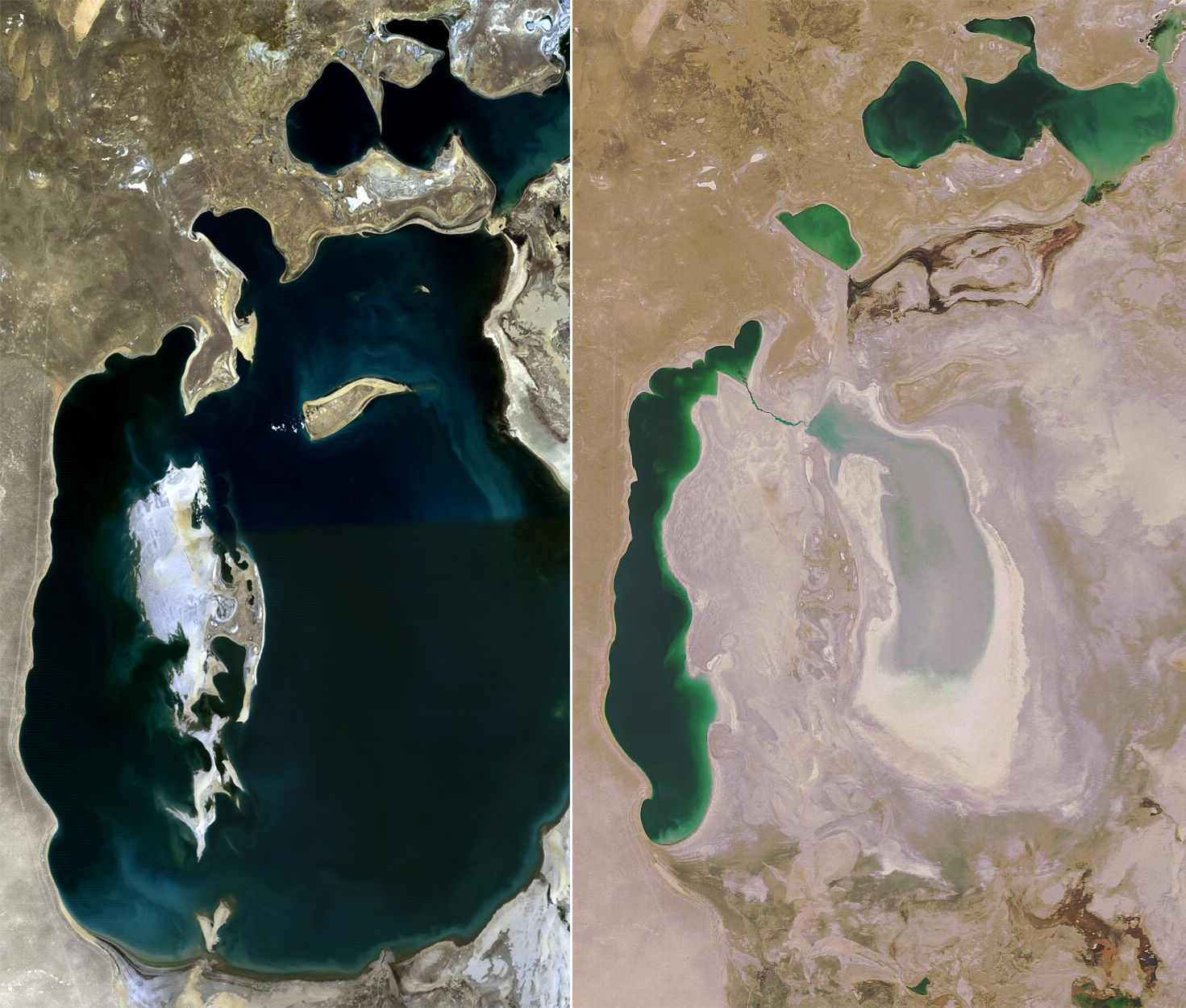
The Aral Sea, lying in Central Asia, has suffered one of the most significant ecological catastrophes of human history in the last few years. In the 1960s, when the Soviet Union diverted the rivers that fed this sea for irrigation purposes (Amu Darya river and Syr Darya river, formerly known as Oxus and Laxartes, respectively, where Alexander the Great would stop to water his horses many centuries ago), the sea started shrinking, to the point that in 1987 the sea split into two lakes. The Aral Sea used to have an area of 68,000 square km, whereas in 1993 its surface area was only 26,687 square km and in 2004 it was reduced to 17,160 square km --that is, it shrank to one fourth of its former surface one century ago. At present, the Aral Sea is just a bunch of small salty lakes. Former coastal towns are deserted; hundreds of boats and ships are stranded on the sand; the water is getting saltier and saltier (from 10 grams per litre to 45 grams per litre); steppe winds sweep the salty crust left after water evaporation, causing the nearby lands to turn into a desert…
To get an idea, we can watch videos and pictures of such catastrophe, but we often feel far from these events and we can hardly imagine their extent. The best way to get a real idea of such catastrophe is by extrapolating this event to our closest sea, one which we know well. What would happen if the Mediterranean Sea shrank in the same proportion? It would be reduced to 633,405 square km, instead of its current surface area of 2,510,000 square km. As it is difficult to imagine, we have customized an image from Google Maps in order to get a clear picture. It is just an artistic recreation, but it gives us a good hint to what is going on in the Aral Sea.
Sources
- The Aral Sea: http://en.wikipedia.org/wiki/Aral_Sea
- Location of the Aral Sea: http://maps.google.es/maps?f=q&source=s_ q&hl=ca&geocode=&q=aral+sea&sll=40.396764,3.713379&sspn=4.852408,14.128418&ie=UTF8&hq=&hnear=Mar+d%27Aral&ll=45.644768,56.381836&spn=4.454796,22.5&t=h&z=6
- Aral Sea from space in 1989 and in 2003: https://blogger.googleusercontent.com/img/b/R29vZ2xl/AVvXsEiam7gEaj4eCHyRrQG9TF-jxzLNFoQYw_wFy7Y8S5wtelqkjovcKSHnMta0pcXAkfmaPhXCc48lZuREMRQzK-hT06ZPnGXNLtHyNjx6cke_lQ-XTWzDYxqF0GHi3lxcYNrwcyeMbXbvt48u/s400/mar+aral+1.jpg
- Aral Sea from space in 2004: http://upload.wikimedia.org/wikipedia/commons/9/95/Aral_Sea_1989-2008.jpg
- Video on Aral Sea catastrophe: http://www.youtube.com/watch?gl=ES&feature=related&hl=es&v=2hu0Hr9eS_g





 Posts
Posts