Monday, December 31, 2012

A time for lists


On the last week of the year, mass media offer lists about the most important pieces of news, the blockbuster films, the best-selling books, the best goals or the prettiest celebrities of the year.
Among all these lists, one of the most amazing is the list of the world’s wealthiest people, published by Forbes. However, we should say “wealthiest men” because there are only 4 women included in the fist 50 top rich people. And this list is published worldwide because it seems that everybody wants to know who the richest man on Earth is. Every Christmas, we are reminded that the Mexican Carlos Sim and the Americans Bill Gates and Warren Buffett are the top three, and the Spanish Amancio Ortega is the fifth thanks to his clothing merchandiser Inditex, including brands like Zara.
However, this list never questions the legitimacy of such fortunes. And it is never said that any of the three richest men on Earth, with a wealth of more than 44 billion dollars, is rich enough to end up with the world’s famine for one year, according to FAO. If we take the top five rich men, they have enough money to eradicate the world’s hunger for six years.
This kind of comparison is usually labelled as demagogic because life is never so simple, but in this case it is. Only if one of these men decided to do things differently, the world could make a positive change. However, if they are the richest men on Earth, they are not likely to be willing to change society.

Sources:
  1. Forbes magazine: http://en.wikipedia.org/wiki/Forbes
  2. Forbes’s with the world’s billionaires: http://www.forbes.com/billionaires/list/
  3. A post at Delivering Data about how much money is needed to eradicate world hunger: http://www.deliveringdata.com/2010/11/how-much-money-is-needed-to-eradicate.html


Monday, December 24, 2012

How much water is on Earth?


It is estimated that the total amount of water in and on the Earth (including saline and fresh water, liquid and solid water in icecaps, groundwater and surface water) amounts to 1,400 million cubic kilometres –that is, about 332,500,000 cubic miles, which is such a large number that we cannot get a clear picture of it.
This water is distributed as a thin layer with a maximum-low depth of 11,000 metres in the Mariana Trench, the deepest part of the world’s oceans located in the western Pacific Ocean. Taking into account that the Earth radius is more than 6,000 km, this trench is not very deep. Jacques Cousteau, the well-known French oceanographer, used a very graphic explanation to understand how thin this layer of water is: if we immerse a billiard ball into water and then dry it with a towel, the moisture film on the surface of this ball will be proportionally higher than the amount of water on our planet. However, this thin layer takes up 71% of the world’s surface, so most of the Earth is water-covered.
This amount of water has been invariable since it first appeared 4,500 million years ago. Water is neither destroyed nor created, so it will always remain the same. However, what is not the same –be it natural or man made—is the condition and distribution of this water.
 

How much is drinking water?
Only 2.5% of the planet’s water can be considered fresh water for its low saline contents. Most terrestrial ecosystems and its species (including humans) need fresh water to survive, so even if it is not a scarce resource, it is a limited resource. Out of this 2.5% of fresh water, 79% is found in the icecaps, 20% is groundwater and only 1% is on the surface. Moreover, out of this 1% of surface water, 50% is in lakes, 38% is soil moisture, 8% is in the atmosphere, 1% is found in living beings (like us) and 1% in rivers. In short: accessible drinking water represents only 0.008% of the total available water in our planet. Get this picture to better understand it: if we could include all the Earth water into a 5-litre container, fresh water would be a teaspoonful, but humans could only drink a couple of droplets from it.

Sources:
  1. These data are taken from the book Guía de bolsillo para personas inquietas: http://www.intermonoxfam.org/es/informate/productos/libros/ciencias-sociales/guia-de-bolsillo-para-personas-inquietas
  2. You can read this book online here: http://books.google.es/books?id=a7vZ4P8KlssC&printsec=frontcover&hl=es&source=gbs_ge_summary_r&cad=0#v=onepage&q&f=false


Monday, December 17, 2012

How do we spend our money?


At the end of October 2012, the Spanish National Institute of Statistics published the Survey of family budget 2011 to check how Spaniards spend their money. This report concludes that the average household expenditure in 2011 amounted to 29,482 € --that is, 1% less than in 2010. The rent item shows the greatest increase, whereas car purchase has been reduced a lot.
But beyond these conclusions, this survey helps us understand our set of values and how we do spend our little money: Spanish households spend 272 € every year in press, books and stationery, standing for 0.9% of our family budget, whereas we spend 894 € in phone services, which represents 3% of our budget. Education represents 1.1 % (311 €), which is less than our budget for shoes (382 €, 1.3%). Medication, pharmaceutical products and other health material represents 1.3% of our expenditure (374 €), which is less than our expenditure in tobacco (436 €, 1.5%). And finally, flowers, pets and other leisure items or equipment stand for 1% (386 €) and jewellery stands for 0.7% (207 €), more or less like our expenditure in press and books.
How does the financial crisis affect our consumption? If we take a look at the family budget of 2006, we’ll realise that the item “press and books” has been reduced in 20.5%, but tobacco has increased in 11.4%.

Sources:
  1. The Spanish National Institute of Statistics: http://en.wikipedia.org/wiki/Instituto_Nacional_de_Estad%C3%ADstica_%28Spain%29
  2. Survey of family budgets 2011: http://www.ine.es/en/prensa/epf_prensa_en.htm


Tuesday, December 11, 2012

Light against the death penalty


On 30 November 1786, that is 226 years ago, death penalty was abolished in the Grand Duchy of Tuscany. It was the first time that a European country legally abolished this penalty. Leopold I, the Grand Duke of Tuscany, as enlightened prince, introduced this reform of the penal code, as well as other laws to boost trade, industry and agrarian productivity, and he suppressed the naval force kept up by the Medici.
To celebrate the first abolition of the death penalty in Europe, the Community of Sant’Egidio, together with 300 more organizations worldwide, launched the international campaign Cities for life to fight against death penalty in the world. For 10 years, every 30 November, more than 1,500 cities around the world light some of their most emblematic buildings to raise public awareness against executions. According to a report drawn by Amnesty International, in 2011 there were 676 people executed in 20 different countries, not including the thousands of people believed to be executed in China, where these figures are top secret. Some other countries like Iran also keep a secret list of executions not included as official information, so the total amount of executed people could double the officially reported figures.
So far, death penalty is abolished in 140 countries. It is quite a major step if we take into account that by the end of the 60s only 55 countries followed the example of Tuscany. At present, there are still 58 countries where death penalty is legal, even if not always applied.
As of 31 December 2011, there were 18,750 people under death sentence worldwide in the death row of many prisons.

Sources:
  1. The Grand Duchy of Tuscany: http://en.wikipedia.org/wiki/Grand_Duchy_of_Tuscany
  2. Leopold I, Grand Duke of Tuscany (later on known as Leopold II, Holy Roman Emperor):  http://en.wikipedia.org/wiki/Leopold_II,_Holy_Roman_Emperor
  3. Community of Sant’Egidio: http://www.santegidio.org/index.php?langID=en
  4. Cities for Life campaign: http://nodeathpenalty.santegidio.org/
  5. Death penalty in 2011, according to Amnesty International: http://www.amnesty.org/en/library/asset/ACT50/001/2012/en/241a8301-05b4-41c0-bfd9-2fe72899cda4/act500012012en.pdf


Sunday, December 2, 2012

Deconstructing international cooperation


The investment of public resources in international cooperation has never been too generous. During the 90s, citizens pushed governments of rich countries into donating 0.7% of their gross national product to cooperation projects, but so far only five countries (Denmark, the Netherlands, Luxemburg, Norway and Sweden) meet this target. The rest of countries don’t, with an average contribution of only 0.3%. And even worse, with the current financial crisis, there have been some cuts in international cooperation budgets. In Spain, regional governments have cut in four years this budget meant for official development assistance (ODA) in 71%.
During the 10th annual meeting of NGO regional coordination held some days ago in Bilbao (Spain), regional governments were reported to go on with such dramatic cuts in 2013. Regional governments are expected to cut an extra 44% on ODA: from the current 240 millions to just 134 million euros.
This dramatic cut has direct consequences: many health, education and nourishment projects in Third World countries are now blocked, and most of the on-going projects are likely to be blocked too at this rate. Moreover, the budget for development education also suffers cuts, affecting all the programmes and campaigns of social awareness and advocacy meant to promote cooperation among Spanish citizens, as well as the importance of individual actions (like what and where we buy things) in our global world.
Contrary to the (relatively) significant social support shown in the demonstrations against the cuts in education and health, cutting the cooperation budget does not seem to be considered unacceptable, as if international cooperation could be left aside during our financial crisis. Maybe we are not aware of the importance of cooperation projects. After all, it is not such a huge budget. By cutting in international cooperation, our financial problems will not get solved: regional cooperation only means 5 euros/year per citizen. However, the defence budget represents 368 euros/year per citizen: we’d rather learn to cut better!

Sources:
  1. The five countries donating 0.7% of their gross national product to cooperation: http://www.oecd.org/investment/aidstatistics/developmentaidrosein2009andmostdonorswillmeet2010aidtargets.htm
  2. The data for this post are taken from official documents of the 10th annual meeting of NGO regional coordination (in Spanish): http://www.congde.org/index.php/noticias/vernoticia/id_noticia/1791


Monday, November 26, 2012

The first cooperative


On October 24, 1844, twenty-eight weavers of Rochdale, a town on the outskirts of Manchester, founded a small co-operative society with the aim of running their own store of basic products (flour, candles, vegetables, tea, clothes…). Members could buy what they needed while getting some benefits too. It was not the first time workers founded a cooperative. The history of the working-class movement includes many attempts towards cooperatives at the beginning of the 19th century, most of them in the UK. But the Rochdale Society of Equitable Pioneers, which is the full name of this society in Rochdale, was the first cooperative sharing benefits among its members, so it is the pioneer society for future cooperatives.
The beginning of this venture was rather hard: it was difficult to get money to set up a store among poor textile workers. After twenty-two calls to its members, there was not enough money to buy a sack of flour. But people soon realised that investing their savings into such society was a good business because this way they could buy good-quality products at affordable prices and, by the end of the year, they could share benefits (a patronage dividend). Soon, this society reported 5% benefits to its members, which is a good interest rate. However, Rochdale weavers could not easily understand what 5% stands for, so they forgot about percentages and rates and started talking about getting 5 extra pounds out of every 100 pound invested. All clear!
By the end of 1844, they could open a store at Toad Lane, and soon, as this society developed, they took the whole building and set up other stores in Rochdale. In 1849, there were 390 members and a capital of 1,193 pounds. In the following year, its membership got doubled and by 1893 there were 12,570 members. This was the onset of the cooperative movement.
At first, the Equitable Pioneers set up a mill (to control the whole process from grains to selling flour), a slaughterhouse, a butcher’s, stables and even a mutual fund. They opened other branches and they helped other cooperatives to develop. In 1863, following Rochdale’s success, there were more than five hundred cooperative stores around the UK. And in 1943, just one century afterwards, the cooperative movement had nine million members in this island.
The key to success for this cooperative was not only sharing patronage dividends, but also caring for education. From the very beginning, when there was not even enough money to buy flour, 2.5% benefits were invested in education. Soon, they could have a library, a bookstore and a newspaper room. In 1850, soon after its foundation, the bookstore had 200 books every week. On the second floor at Toad Lane, every evening and every weekend there were conferences and courses on science, history, politics and economy. Thanks to the promotion of education and culture, Rochdale workers could make the best of their skills, favouring the cooperative management, people’s involvement and participation and the spreading of their principles.
The “28 people” in Rochdale who set up a dim store in the outskirts of an industrial town more than 150 years ago have now become an icon of the cooperative movement. Most of their principles are still valid. Therefore, it was a very significant milestone in our history, but most people never heard about it.
At school, when we talk about crucial moments in our history, we always refer to battles, treaties and scientific or geographic discoveries, but we rarely talk about such social landmarks. Maybe we should give more importance to people and movements changing our society and working towards justice and social welfare.

Sources:
  1. Most information in this post is taken from George Jacob Holyoake’s book The History of the Rochdale Pioneers: http://www26.us.archive.org/details/historyofrochdal00holyuoft
  2. Rochdale, on the outskirts of Manchester: http://www.rochdale.gov.uk/
  3. The onset of the working-class movements: http://en.wikipedia.org/wiki/Utopian_socialism
  4. About the Rochdale Society of Equitable Pioneers: http://en.wikipedia.org/wiki/Rochdale_Society_of_Equitable_Pioneers
  5. Rochdale principles: http://en.wikipedia.org/wiki/Rochdale_Principles


Sunday, November 18, 2012

Buying clothes at the supermarket


There are more and more people who buy clothes at the supermarket. These clothes are cheaper and you can buy them while filling your shopping cart with groceries. Convenience and low prices are key to turn discount retailers into an outlet of clothes and shoes. In 2005, giant retailers sold 54,000 million euros in clothes and shoes, which represents 6% of global sales. And these figures increase every year. 
At present, the largest corporation is a department store: Walmart, from the US, is largest retailer in the world. Every week, 175 million people buy there. The second and third top supermarkets are the English Tesco (with 30 million customers every week) and the French Carrefour (with 25 million customers). The fourth and fifth positions are for German discount retailers Lidl and Aldi. All these retailers offer such low prices that they are becoming more and more popular (thanks to the financial crisis too) and in 2012 they represented 20% of the market share.
Clothes sold in such department stores are of poor quality, like most other products. But it is so cheap that customers find it convenient and when it wears out, people throw it away and buy new clothes. However, such low prices hide a secret. The Clean Clothes Campaign, launched by many NGOs, unions and consumer’s associations worldwide, advocates to improve the work conditions in the garment industry and minimize the environmental impact of clothes manufacturing. This campaign includes a report about clothes sold by giant retailers. The conclusions of this report are clear: working conditions in the garment industry are very precarious because supermarkets and retailers push suppliers into selling at very low prices. Under such pressure, manufacturers (working always in poor countries with inadequate or inexistent work regulations) pay miserable salaries, offer no safety to their employees and dump chemical products into the environment.
Just to set an example: in 2006, the number of garment companies supplying clothes to Walmart with a “medium-risk” or “high-risk” violation of work standards represented 91%. And bear in mind that these working standards are very low: most clothes manufacturers set a minimum wage of just 50% of the living wage. In Bangalore (India), for instance, an average family needs 80 euros to cover their basic needs, but most workers in this area just earn 42 euros. In Sri Lanka, only 43.9% of workers earn a salary equal to or greater than the minimum living wage established by law in this country. Moreover, most of these companies do not allow unions, and work contracts are for the short-term and very precarious.
Not only clothes manufacturers have a hard time: shop assistants and store clerks also have poor work conditions. Walmart employs 2 million people for distribution and sales (not including product manufacturers) with the following work conditions: a maximum of 72 hours/week, no minimum wage and worse conditions every day. Therefore, it is easy to understand how such discount retailers can offer really low prices. But it is worth buying these products?
Two more data to better understand the consequences of buying cheap clothes. As these clothes are imported from very far-away countries, every department store releases three times more CO2 emissions than any local shop. And, as average, having a giant retailer involves loosing 276 job posts and closing local shops within a 12-km radius.

Sources:
  1. Clean Clothes Campaign: http://www.cleanclothes.org/
  2. The data of this post is taken from the report Cashing In: Giant retailers, purchasing practice and working conditions in the garment industry drawn by the Clean Clothes Campaign (available in several languages): https://www.cleanclothes.org/resources/ccc/working-conditions/cashing-in


Monday, November 12, 2012

Become a fish fighter!


Not long ago, we published a post in this blog about the problems of overfishing and the extinction of ocean resources. At present, oceans are in dire straits. In the last 60 years, 90% of large fish have disappeared and, at this rate, in 2050 there will be no more fish to catch. 75% of the world’s fish stocks are overexploited and, in the Mediterranean Sea, which is small but with densely populated shores, this percentage is even larger: 87%.
In terms of consumption, Spain is one of the countries with the highest fish consumption in the world. But it is not fish caught in the Spanish shores: Spaniards eat fish from all around the world. If in 2012 Spaniards ate fish from its shores, in May 2012 there would be no fish left there. Therefore, fish consumption in Spain exceeds its reasonable amounts. And on top of that, a lot of fish caught from the ocean is not even consumed: it is thrown back overboard dead, because it does not have a good size, or it is not a popular species to eat, or it exceeds the number of tonnes fished of a given species allowed for each boat.
And we are not talking of just some fish: we are talking of 42% of fish trawled by large fishing boats which is thrown back overboard dead. This way, every year in Europe, one million tonnes of fish is discarded. What an insane waste!
In order to avoid this malpractice, the international campaign Fish Fight is collecting signatures to put pressure on the European Commissioner for Maritime Affairs and Fisheries. The EU fishery policies are being discussed and it is important to be heard so that this insane waste is put to an end.
More data: trawling boats discard 42% of the fish caught, whereas small traditional fishing boats only discard 3% of fish. And also, the later employ more people, preserve millenary traditions and the catch is local.

Sources
  1. Post at Delivering Data about salmon fishing:
  2. Website about overfishing, a global disaster: http://overfishing.org/
  3. Every year, one million tons of fish is thrown overboard dead in Europe: http://www.guardian.co.uk/environment/2012/jun/13/fishing-discards-ban-eu
  4. Large fishing boats: http://gustavoduch.wordpress.com/2012/11/07/la-extincion-2/
  5. Fish Fight campaign: http://www.fishfight.net/
  6. A very interesting website about the EU fisheries policies: http://www.fishforthefuture.eu/


Monday, November 5, 2012

Lo que hay que Wert!


For the first time in our blog, we are not the authors of this post. Our guest is José Ignacio Wert, the current Spanish Minister of Education, Culture and Sports, because writing about cuts in the Spanish education system only requires a copy-paste of the Spanish Minister’s best quotes about education.  Such shameful pearls of wisdom are published in the website Lo que hay que Wert, which is a campaign launched by the NGO Educación Sin Fronteras (Education Without Borders) to claim that the education budget of 2013 should be at least like the education budget of 2011.
The Spanish Minister of Education, Culture and Sports said:
  • "Public education is no longer contributing to our society".
  • "Populist temptation is everywhere, but when people say that government should help people instead of helping banks, the claim is formulated wrongly, because helping banks means helping people".
  • [About overcrowded schools] "We should bear in mind that, besides learning, kids go to school to mingle with other kids, communicate with each other, have different experiences… And this would be very difficult if there were few kids in each classroom”.
  • [About the brain drain] "I don’t think it should be called brain drain. It is not negative at all to have young people with skills and willingness to move around, who can speak foreign languages, who are willing to live far from home, who wish to broaden their professional scope…".
  • "The concept of school community is abusive and invasive. The idea of a managing board made up of parents, students, teachers and non-teaching staff is not possible because schools are not a democracy, as education is not a democratic process”.
  • "What do you mean that some families do not have enough resources to pay school taxes? Maybe these families prefer spending their money on other things than schooling ".
If you are against cuts in education, sign up here, and talk about it.

Sources:
  1. José Ignacio Wert: http://es.wikipedia.org/wiki/Jos%C3%A9_Ignacio_Wert
  2. Campaign Lo que hay que Wert: www.loquehayquewert.org
  3. Educación Sin Fronteras: http://www.educacionsinfronteras.org
  4. Sign here against the cuts in education: http://www.loquehayquewert.org/firma.php


Sunday, October 28, 2012

Immigration Detention Centres, our next-door concentration camps


In 1985 the Spanish government approved an immigration law including detention centres (CIES in Spanish) for immigrants who do not have papers in order, but are not to be imprisoned. According to this law, immigrants should spend a maximum of 40 days in those detention centres until they are expelled from Spain.  
In 1995, with the implementation of the Schengen Agreement, many detention centres were built around Europe. In Spain, even if these centres are managed by the Ministry of Home Affairs, there is no official information about the exact number of centres and the exact number of people in detention. According to the campaign Stop CIES, conducted by the NGO “SOS Racisme” and the Barcelona Youth Council, there are 280 detention centres in Europe, including 11 in Spain. Now-a-days, with the new detention law, immigrants can spend there 60 days. 
Several organisations denounced that immigrants are ill-treated in these centres, to the point that in the detention centre of Barcelona there have been four casualties so far. The Spanish Minister of Home Affairs argues that they were all natural deaths, except for a suicide, but there is no way to check it out. There is no control on police actions in these centres, there are no annual reports, no lists of immigrants in detention, no financial reports and no public information made available. In short, it is like a concentration camp for people who have committed no crime (not having your papers in order is not a crime but just an administrative offence), and these people are denied most of their rights.
At the beginning of 2012, several campaigns against these shameful centres were reported in the mass media. The Catalan ombudsman decided to enter the detention centre in Barcelona with some journalists to make an inspection, but they were not allowed in. Some days later, the Spanish Minister of Home Affairs allowed some journalists to enter this centre in an attempt to improve the public opinion about CIES. As a result, from now on, detention centres will be named CECE in Spain (Centres for the Controlled Stay of Foreigners), which allegedly sounds better. But they are still the same: detention centres without any transparent information.
As citizens, we get almost no information about the existence of detention centres or what happens there, but we are an accessory nonetheless. Detention centres are like concentration camps, and they may be located next door.

Sources:
  1. Organic Law 7/1985 on Rights and Liberties of the Foreigners in Spain: http://www.boe.es/buscar/doc.php?id=BOE-A-1985-12767
  2. The Schengen Agreement: http://en.wikipedia.org/wiki/Schengen_Agreement
  3. Information of the Spanish Ministry of Home Affairs about detention centres: http://www.interior.gob.es/extranjeria-28/regimen-general-189/centro-de-internamiento-de-extranjeros-208?locale=es
  4. Campaign against detention centres: http://ciesno.wordpress.com/about/
  5. A young man dies in the detention centre of Barcelona: http://elpais.com/elpais/2012/01/06/inenglish/1325830851_850210.html
  6. Not having your papers in order is not a crime but an administrative offence: http://www.papelesespana.com/documentacion/sin-papeles.html
  7. Journalist entering the detention centre in Barcelona: http://www.elmundo.es/elmundo/2012/04/26/barcelona/1335425279.html
  8. Detention centres are named differently: http://www.abc.es/20120612/espana/abci-cies-anteproyecto-novedades-201206112037.html


Sunday, October 21, 2012

A living planet


With more than five million members, the World Wide Fund for Nature (WWF) is the world’s largest conservation organisation. 
In spring 2012 it became notorious because one of its honorary presidents, the Spanish King Juan Carlos, went hunting elephants in Botswana. This NGO received mass criticism to have a hunter as honorary president of the Spanish section, being a wildlife conservation organization. In July, an extraordinary assembly decided to sack him with a vote carried by a 94% majority. However, it was a hard blow for the image of this organization and some members resigned.
WWF has been linked to the monarchies for a long time. One of its founders was the Prince Consort of the Netherlands, Prince Bernhard of Lippe-Biesterfeld, and its current president is Charles, Prince of Wales. The aim is having international projection and making sure that WWF acts and campaigns appear not only in environmental publications but also in gossip magazines, to reach many more people, more or less as if we were talking of goodwill ambassadors
Leaving this issue aside, WWF plays a very important role. This NGO creates and manages many protected areas, launches campaigns to protect species, collaborates with indigenous communities to preserve territories… WWF has more than 1,200 projects around the world. 
And besides this field work, WWF also plays a significant role in denouncing environmental problems of our planet. Among other documents, this organization publishes a report called the Living Planet, analysing the health of our planet, with many data and proposals for a better future. Read this report and you will learn how things are and which problems we should face. And, most importantly, you will realise that we should change many things: either we reduce the impact of human activity on the environment or our future is doomed to failure. 
Some data from this report, which we encourage you to read:
  • The planet biodiversity in the last 35 years has been reduced by 30%.
  • Our current consumption of raw materials exceeds by 50% the planet’s regenerating capacity. We live in one planet, but we consume as if we were living in one and a half planets. 
  • Deforestation and forest degradation account for 20% of our CO2 emissions into the atmosphere. 
  • Only a third of the world’s rivers longer than 1,000 km are free flowing, without dams.
  • In the last 50 years, global sea fishing has increased five-fold, so many species are overexploited. 
  • The past few decades have been warmer than any other comparable period for the last 400 years.
Sources:

  1. World Wide Fund for Nature (WWF): http://en.wikipedia.org/wiki/World_Wide_Fund_for_Nature
  2. WWF removes King Juan Carlos as its honorary president: http://www.bbc.co.uk/news/world-europe-18942736
  3. Goodwill ambassadors: http://www.deliveringdata.com/2011/07/goodwill-ambassadors.html
  4. Living Planet Report 2012: http://awsassets.panda.org/downloads/1_lpr_2012_online_full_size_single_pages_final_120516.pdf

Monday, October 15, 2012

The price of a cereal box

Original photo by Dr. Roy Winkelman from ClippixETC

The giants of the food industry (Nestlé, Kellogg, Kraft, General Foods, etc.) are the ones imposing rules on the food market. On the one hand, they can decide which price is paid to farmers for raw materials. On the other, they put pressure on retailers to favour their company products and get a larger profit margin. They can even have a saying on the advertising campaigns in supermarkets.  
In order to understand who rules the roost in the food sector, we should take a look at the benefit percentage of each actor playing a role in the whole manufacturing and sale process. We took the data from a cereal box, which can be easily extrapolated in most countries. 

The farmer gets about 7% of the final price. Taking an average cereal box costing 3.5 €, this means that the farmer gets 25 cents. Only a little tiny part of these 25 cents are real benefits for the farmer, because he has to cover the expenses of seeds, machinery, fertilisers, plot rental…
73% of the final price of a cereal box is for the processing company, which includes 29% for processing and packaging and 44% as real benefits. The processing company is, by far, the one who gets the best deal.
And finally, the retailer gets about 20%. This percentage is different if the retailer is a large supermarket, with more power to negotiate, or a grocer’s shop. This percentage includes all possible benefits.

The journalist Paul Roberts, who is specialised on this issue, summarises the whole idea: «The ability to generate such huge margins is why food companies have moved steadily and inexorably toward higher and higher levels of processing: the more a company processes a raw material and the closer that commodity comes to being a finished consumer product, the more the company can charge. In 1950, about half the retail price of a food product went to pay the farmer or other producer of raw materials, while half went to adding value. By 2000 this farm share had fallen below 20%. What this means is that even as farmers and other producers earned steadily less on their products, food processors and manufacturers were able to maintain their own revenues by steadily adding more value.»

Sources:
  1. Data are taken from this book: John Connor et al. The Food Manufacturing Industries: Structure, Strategies, Performance and Polices. Lexington Books, page 66: http://trove.nla.gov.au/work/22263342?selectedversion=NBD3245057
  2. These data are also mentioned in Paul Roberts’ book The End of Food: http://www.theendoffood.com/


Tuesday, October 9, 2012

Critical mass: 20 years celebrating bicycle rides


Bicycles do not block traffic: we are traffic. With this idea in mind, on 25 September 1992 about fifty cyclists in San Francisco (US) rode around this town to claim the use of bicycles. This idea came up after watching Ted White’s documentary film The Return of the Scorcher, describing traffic in some towns in China, where cyclists are not respected, so they wait until there are some more cyclists at a traffic light to cross large avenue as a single vehicle.
In the field of sociology, the expression critical mass is used to classify a sufficient number of people to make any phenomenon possible. This idea comes from the field of physics, and this group of cyclists from San Francisco adopted it to call their cycling event. The idea is quite simple: a bunch of cyclist meets once a month to ride around their town all together. As simple as that: it is not a demonstration, the area is not closed to traffic, so there is no argument between cyclists and drivers or cyclists and police officers. The point is making people get used to seeing bicycles around, because bicycles are part of the city traffic and they deserve the same respect as the rest of vehicles. It is a peaceful, celebratory event, often involving the whole family. 
This phenomenon soon spread around. In the following year, more than one thousand cyclists took part in San Francisco rides, and at present this event is celebrated in about 400 towns worldwide. If you want to know where and when the next cycling event is, check this web site.
Last month it was the twentieth anniversary of the first critical mass, but it became a real “critical mass” not so long ago. More and more people take part in these cycling meetings (be them regular or sporadic cyclists) because they understand that riding is not just a game for kids or a weekend hobby, but an alternative vehicle which is healthier, cheaper and more respectful with the environment than any other means of transport.
Ride your bicycle every day, and celebrate it once a month!

Sources:
  1. The documentary film The Return of the Scorcher: http://www.youtube.com/watch?v=gF-ddhcnT-s
  2. What “critical mass” means:  http://en.wikipedia.org/wiki/Critical_mass_%28sociodynamics%29
  3. When and where the next ride is: http://criticalmass.wikia.com/wiki/List_of_rides


Monday, October 1, 2012

KM 0 restaurants


Every year, 29,000 million kg of food is imported in Spain. That is, more than 700 kg every year per citizen. This is a major environmental atrocity, so in this blog we recently talked about some worldwide initiatives that advocate for local produce. In short, it is all about consuming products and food grown or manufactured nearby, so that we can all reduce the environmental impact of transport and reduce the problems of single-crop farming in Third World countries.
These initiatives are known by many names: km 0, 100-miles diet (or 100-km diet), Local Food, low CO2 diet or Locavore, just to set a few well-known examples, but there are many more.  
As any other change in our habits, promoting local produce in our everyday life is not easy and it will take its time. Although people have talked about it for a long time, there are not too many people who follow this diet. But consumers are gradually taking into account proximity values when going shopping.
One of the main actors implementing this “new” consumption model (which is not new, because our grandparents followed it) are restaurants. Recently, many bars and restaurants joined this movement and they play a significant role in promoting its qualities and making people realise that this is the only sustainable possibility. Thanks to these restaurants, citizens can have access to an excellent cuisine (with great variety and excellent quality) without importing products from far-away countries. And this movement includes bars serving sandwiches as well as sophisticated restaurants.
When we choose a restaurant, we usually take into account several factors: quality, price, location, the premises, the waiters’ kindness and the cook’s skills. From now on, we should include a new factor: local products. To help you in this hard choice, here you have some websites with the best Slow Food restaurants. Bon appetite!

KM 0 restaurants:

Sources:
  1. Post at Delivering Data about imported food: http://www.deliveringdata.com/2012/05/food-from-far-and-near.html
  2. Post at Delivering Data about local produce: http://www.deliveringdata.com/2011/08/food-without-borders.html


Sunday, September 23, 2012

A crisis-free army


Some weeks ago we published a post comparing cuts in fire trucks (and in fire-fighting in general) and the purchase of 772 military trucks by the Spanish army, for which the Spanish government paid 149 million euros (VAT not included). It seems that the economical crisis is not affecting the Spanish Ministry of Defense, and the purchase of military trucks is not an isolated example. 
Recently, the Cabinet of Spain approved an extraordinary credit of 1,782 million euros for arms. This means increasing the Defense budget by 28.21%. Social services suffer major cuts, but the army budget is still growing.
Another example of wasting money in the Spanish army is the purchase of military helicopters NH90 announced by the Spanish Government. The initial order, submitted in 2006, was 45 helicopters, and the current order is 38. Some days ago the Spanish King flew one of these helicopters as a grand debut in the Spanish society. 
Every helicopter costs 25 million euros, so this purchase means 950 million euros wasted in useless means of transport for Spanish citizens. And meanwhile, due to the economical crisis, the Spanish government makes major cuts in civil helicopters, to the point that in Andalusia and the Balearic Islands there is no helicopter for mountain rescue. The reason: there is not money left. 


Sources:

Post at Delivering data about the purchase of military trucks:
http://www.deliveringdata.com/2012/08/trucks-versus-trucks.html
Extraordinary credit of 1,782 million euros:
http://thefreeonline.wordpress.com/2012/09/14/bankrupt-spain-defense-budget-increased-by-30/
NH90 helicopter: http://en.wikipedia.org/wiki/NHIndustries_NH90
The Spanish King wants to check the new helicopter:
https://www.eurocopter.com/site/en/press/King-Juan-Carlos-I-Takes-to-the-Air-in-the-Spanish-NH90-Helicopter_970.html?iframe=true&width=700
Cuts in rescue helicopters: http://desnivel.com/escalada-roca/retiran-los-helicopteros-de-rescate-de-bomberos-en-andalucia-y-mallorca-y-mas-problemas-en-alicante


Monday, September 17, 2012

Megadiversity countries


Some areas in our planet are richer in biodiversity than others. Those areas with a higher density of different species are not necessarily where the environment is best protected –it is rather thanks to the type of ecosystem. Tropical rainforests are the top biodiversity-rich ecosystems: only the Amazon rainforest harbours one out of every ten known species of our planet.
Therefore, some countries have a major responsibility to protect this diversity, so the World Conservation Monitoring Centre of the UN Environment Programme (UNEP-WCMC) has been working on this issue since 1988. Up to now, it has identified 17 megadiverse countries, that is, those countries with the highest number of endemic species –at least 5,000 endemic plants.
The world’s top biodiversity-rich continent is America, with 7 megadiverse countries:
- Brazil
- Colombia
- Ecuador
- Unites States
- Mexico
- Peru
- Venezuela
Asia ranks the second, with 5 megadiverse countries:
- The Philippines
- India
- Indonesia
- Malaysia
- China
Africa ranks number three, with 3 megadiverse countries:
- Madagascar
- Democratic Republic of the Congo
- Republic of South Africa
Oceania ranks number 4, with 2 megadiverse countries:
- Australia
- Papua New Guinea
Europe has no megadiverse country.

Sources:
  1. Biodiversity: http://en.wikipedia.org/wiki/Biodiversity
  2. Biodiversity in the Amazon rainforest: http://wwf.panda.org/what_we_do/where_we_work/amazon/
  3. World Conservation Monitoring Centre of the UN Environment Programme: http://www.unep-wcmc.org/
  4. Megadiversity countries: http://www.biodiversitya-z.org/areas/26
  5. Endemic species: http://en.wikipedia.org/wiki/Endemism


Sunday, September 2, 2012

Language diversity in New Guinea


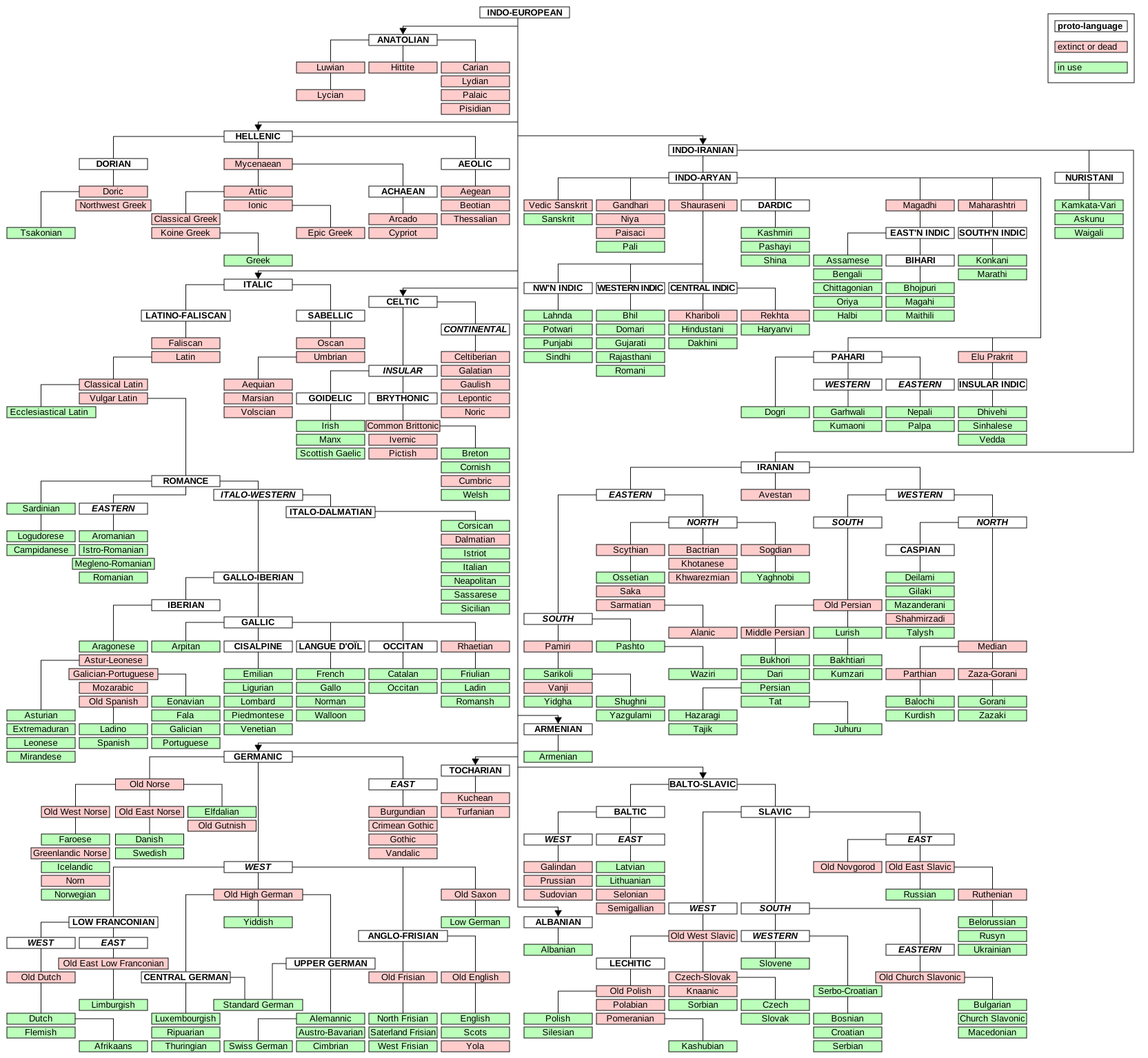
English is an Indo-European language like French, Persian, Urdu, Catalan, Russian, Greek or Bengali. It is the most largely-spoken language family in our world: half the inhabitants of our planet speak one Indo-European language. But out of the current 7,000 living languages in the world, only 6.5% (about 450 languages) belong to this family. Therefore, it is a family with few languages but many speakers.
On the island of New Guinea we find the opposite situation: there are many languages but few speakers. It is the world’s area with the richest language diversity by far, although it has less than 8 million inhabitants.
New Guinea is the world’s second largest island after Greenland (Australia is considered to be a continent), covering a land area of 786,000 km2 (more or less like Turkey or one and a half Spain). The western part belongs to Indonesia whereas the eastern part is an independent state since 1975: Papua New Guinea.
According to Ethnologue: Languages of the World, one of the main references in this field, a total of 1,073 languages are spoken on this island: 826 in Papua New Guinea and 257 in the western part of the island. These figures represent more than 15% of the 6,909 living languages recorded by this encyclopaedic catalogue in the whole world. Most of these languages belong to the Austronesian group and the Papuan group, which are the world’s second and third families with most languages after the Niger-Congo language family.
In Spain we have less than a dozen autochthonous languages, and only five of them are considered to be co-official. However, there are still many Spaniards who consider that such “language diversity” may pose some problems. What may New Guineans think of a country like Spain?

Sources:
  1. Indo-European languages: http://upload.wikimedia.org/wikipedia/commons/4/4f/IndoEuropeanTree.svg
  2. New Guinea island: http://goo.gl/maps/TaC0h
  3. List of countries by area: http://en.wikipedia.org/wiki/List_of_countries_and_dependencies_by_area
  4. Indonesia: http://en.wikipedia.org/wiki/Indonesia
  5. Papua New Guinea: http://en.wikipedia.org/wiki/Papua_New_Guinea
  6. Ethnologue: Languages of the World web site: http://www.ethnologue.com/
  7. Austronesian languages: http://en.wikipedia.org/wiki/Austronesian_languages
  8. Papuan languages: http://en.wikipedia.org/wiki/Papuan_languages
  9. Languages of Spain: http://en.wikipedia.org/wiki/Languages_of_Spain


Sunday, August 26, 2012

Trucks versus trucks


Spain is suffering one of the worst summers ever for the last 20 years in terms of forest fires. The largest forest areas destroyed by the fire are in Valencia, Catalonia and the Canary Islands, but most Spanish regions have suffered one or two forest fires. On 12 August, still in mid summer season, 140,000 hectares were already burnt. Just to get a clear picture: there are 67 countries in the world with a smaller surface area than the amount of hectares destroyed by fire in Spain. All these fires are due to different causes. On the one hand, Spain had some very rainy years followed by a very dry winter and an extremely hot summer, which is the perfect scenario to get a very thick and dry shrub layer, ready to burn. But on the other hand, there is another actor in this story: major cuts in fire brigades and clearout programmes imposed by the Spanish government and local authorities. Only in Valencia, the local authorities cut the budget to fight against forest fires in 15 million euros.
The Spanish authorities justify these major cuts with the current financial crisis: budgets should be cut if there is less money. True enough, but these cuts could be more selective. Last March, just to set an example, the Spanish government authorised the purchase of 772 military trucks for 149 million euros (no VAT included). We’d better buy fire trucks, don’t you think?

Sources:
  1. Article at The Guardian about summer wildfires in Spain: http://www.guardian.co.uk/world/2012/aug/22/cuts-blamed-deaths-spanish-wildfires
  2. Summer wildfires in Spain: http://www.greenpeace.org/espana/es/Trabajamos-en/Bosques/Incendios-forestales-en-Espana/
  3. On 12 August, 140,000 hectares were already burnt: http://www.greenpeace.org/espana/es/Blog/ms-presupuestos-y-menos-demagogia-contra-los-/blog/41820/
  4. List of countries by total area: http://en.wikipedia.org/wiki/List_of_countries_and_outlying_territories_by_total_area
  5. Major cuts in Valencia: http://politica.elpais.com/politica/2012/06/30/actualidad/1341074103_491294.html
  6. The purchase of military trucks: http://www.europapress.es/nacional/noticia-consejo-gobierno-autoriza-compra-772-camiones-militares-mas-149-millones-euros-20120309155558.html


Monday, August 13, 2012

Golf courses and other outrages


Golf courses and ski runs are the sports fields with the worst environmental impact. At first glance, nobody would believe it because these fields are very green (or white) and they look much more “natural” than a basketball court. But golf courses or ski runs are built in the middle of “really” green areas and they waste a huge amount of water for maintenance purposes, so these sports fields are real predators for our environment.
Two data to better understand the amount of water necessary to keep a golf course:
  • According to WWF/Adena, a golf course by the Mediterranean sea guzzles as much water as a town of 12,000 inhabitants.
  • Only in the US, golf courses require 7,800 million litres of water every day. Bear in mind that the US has a population of about 310 million people, so every day more than 25 litres per person are meant to water golf courses.

Recently, some solutions are being tested to solve this problem, including the introduction of a grass family of Paspalum genus, which can be watered with salt water. Moreover, this type of grass does not need to be watered so often. However, there is a more sustainable, simple and cheap solution: try another sport to have a good time.

Sources:
WWF data about golf courses:
http://mediterranean.panda.org/?14176/Mediterranean-water-resources-threatened-by-expanding-tourism
The data about the amount of water guzzled in US golf courses is taken from the printed edition of National Geographic (April 2010 issue):
http://www.nationalgeographic.com
US population: http://en.wikipedia.org/wiki/United_States
Grass of Paspalum genus: http://en.wikipedia.org/wiki/Paspalum


Sunday, August 5, 2012

The Iberian lynx


There are four species of lynx around the world and three of them are not endangered because they can be found in large areas of the northern hemisphere. But a fourth species, the Iberian lynx (lynx pardinus), is the most endangered felid in the world. There are only two or three hundred individuals in some natural parks in the south and west of the Iberian Peninsula (Southern Europe). 
As usual among those critically endangered large mammals, the Iberian lynx has become an icon, especially in Spain since the late 1980s, when the first scientific census was conducted, resulting in a total amount of only 1,200 individuals, with no more than 350 reproductive females. Then people became aware of the species endangerment, so some campaigns were launched to save the Iberian Lynx. This animal became the protagonist of most TV and radio programmes, as well as books and encyclopaedias about the Iberian fauna. At present, the image of a lynx is so attached to the idea of threatened species and extinction that it is even used in other campaigns which have nothing to do with this animal. It seemed we could remedy this problem. But the situation of this feline species got even worse.
By the mid 1980s, the rabbit hemorrhagic disease virus first appeared in China and it soon spread around the world, killing rabbits everywhere. For instance, in Italy, this outbreak killed 80% farm bunnies. But what does it have to do with the Iberian lynx? Easy: wild rabbits represent 90% to 100% of the lynx diet, so the massive death of rabbits resulted in the death of many individuals of lynx in most of its native areas. Final outcome: at the beginning of the 21st century there were only 84 to 143 individuals (kittens excluded) worldwide.
In this last decade, many protection and investment funds have been launched to avoid the extinction of the Iberian lynx. Thanks to this effort, the population has tripled and its habitat has doubled. Moreover, about one hundred individuals are kept in captivity to make them breed and then release them again in the wild. But the future of the Iberian lynx is still in imminent danger, so we could easily loose a treasure.

Sources:
  1. The Iberian lynx: http://en.wikipedia.org/wiki/Iberian_lynx
  2. The most endangered feline species in the world: http://www.iberianature.com/material/documents/LynxBrief12E.pdf
  3. First WWF newsletter about the Iberian Lynx: http://awsassets.wwf.es/downloads/lince_online_english_newsletter.pdf
  4. The rabbit hemorrhagic virus (RHV): http://en.wikipedia.org/wiki/Rabbit_hemorrhagic_disease_virus
  5. Campaign launched by the Spanish Catholic Church against abortion using the image of a lynx: http://www.cadenaser.com/sociedad/articulo/conferencia-episcopal-lanza-nueva-campana-aborto/csrcsrpor/20090316csrcsrsoc_3/Tes