Sunday, December 26, 2010

The world without us


What would happen if, all of a sudden, all human beings disappeared from Earth, leaving our buildings and products behind? How much time would Earth need to erase our impact on the planet? With no-one to control our residues, could there be any disastrous accident? These are some of the questions that the journalist Alan Weisman approaches in The World Without Us, a popular science book in which the author talks about how houses and cities would collapse, how nature would regain concrete and asphalt, what would happen with nuclear stations and nuclear residues, or which animal species or plants would benefit or be damaged from our extinction.
Here you have some clues: our planet would need 100,000 years to restore the levels of carbon dioxide back to pre-human presence; it would take 35,000 years to cleanse the lead deposited during the smokestack era from the soil; with high-voltage lines and glass towers down, together with other dangers built by humans, every year a billion doomed birds would survive; with all draining systems in the urban subsoil no longer working, streets would soon subside, along with houses some years later… Would cities disappear without a trace? If you want answers, you’d better read the book.

Sources:
  1. The World Without Us: http://www.worldwithoutus.com/index2.html
  2. Examples from the book: http://www.worldwithoutus.com/did_you_know.html
  3.    
      

Sunday, December 19, 2010

Public corruption, private corruption

                                                                                                Oriol Bosch
Last 9 December, on the occasion of the International Anti-Corruption Day, the Anti-Fraud Office of Catalonia published the survey Corruption in Catalonia: civic perceptions and attitudes. This is the first time that such a thorough survey is ever presented in this country and results are quite interesting.
One of the most astonishing results in this survey is that Catalan citizens are very intransigent with political corruption, but they are rather permissive with business corruption and little everyday corrupt behaviours. For instance, 85% of those polled consider that corruption is more or quite spread in political parties and 21.7% states that the main motivation to become a politician is personal enrichment, whereas only 57% of polled citizens think that trips paid by pharmaceutical laboratories to doctors of the public health systems are to be considered corrupt behaviour.
In this line, 59.4% believe that in cases of corruption between public administrations and private companies, the main responsible is the administration.
Moreover, and much to our regret, citizens consider that fighting for transparency is pointless: 44% believe that corruption is unavoidable and 74% think that we all have a price. Do we?

Sources:
  1. International Anti-Corruption Day: http://www.un.org/depts/dhl/events/anti_corruption/index.html
  2. Anti-Fraud Office in Catalonia:  http://www.antifrau.cat/en.html
  3. Survey on citizens’ attitudes and perception of corruption in Catalonia: http://www.antifrau.cat/en/highlightseng/224-presentacio-de-la-primera-enquesta-sobre-les-actituds-i-la-percepcio-ciutadana-davant-la-corrupcio-a-catalunya.html
 

Sunday, December 12, 2010

World War II is not over yet

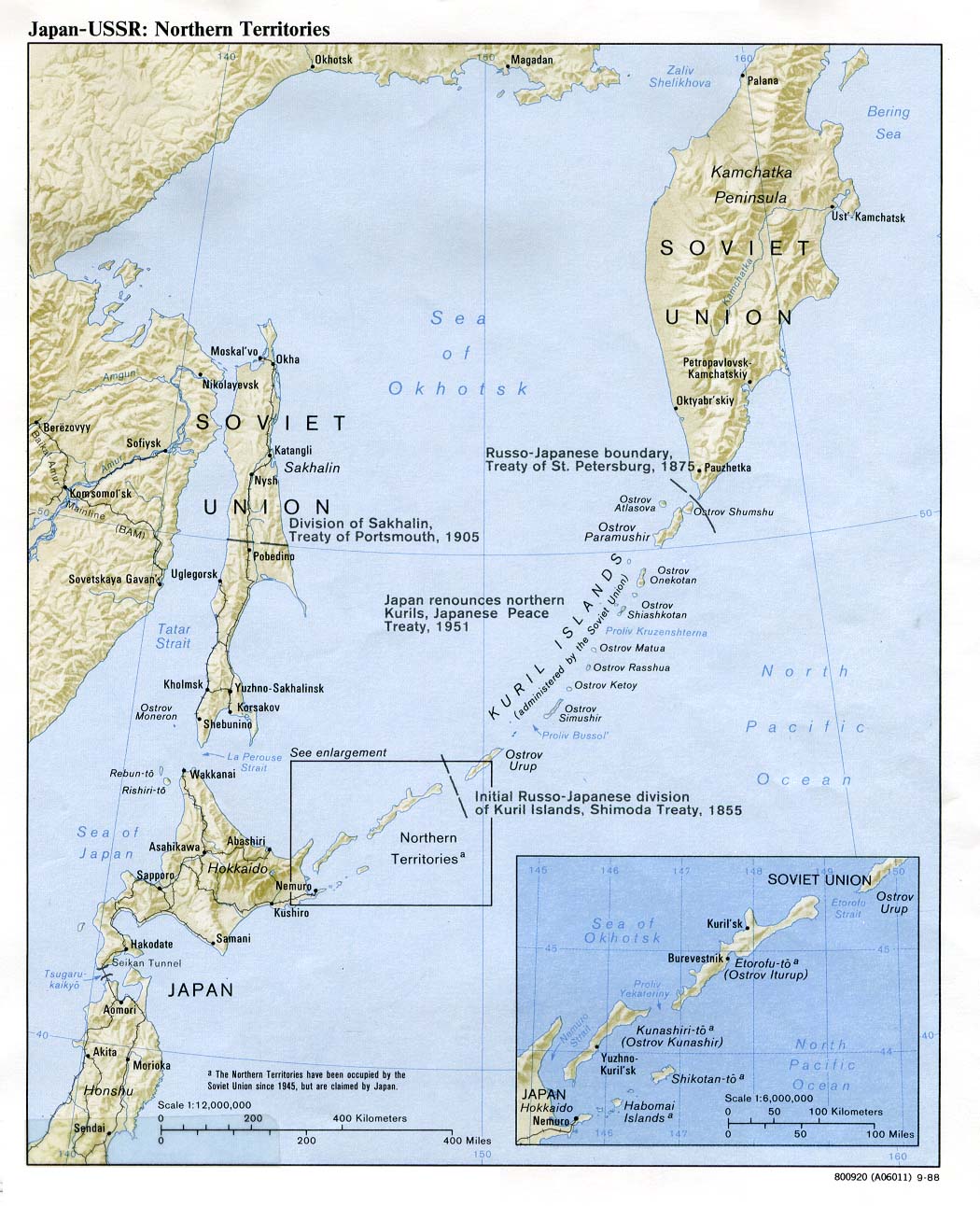
Most history books say that World War II ended on 2 September 1945, the day when Japan signed the official surrender with the Allies. Some other books say it ended on 14 August 1945, when Japan admitted their defeat, although some weeks elapsed until the formal surrender was signed. However, for the Soviet troops, war ended on 9 May 1945, the Victory Day in the Soviet Union. There are many more dates: 8 May 1945, when the Allies celebrate the Victory Day in Europe; 12 May 1945, when the last German troops surrendered in Prague; 9 September 1945, when the last Japanese troops surrendered in China… This is quite usual in wars: there is the official end of war, the day of peace treaties and the date of real end of combats, regardless of what Joint Chiefs of Staff say. Choosing one of these dates as the main day for the end of war, that is, as the date included in history books, is just a convention. However, World War II is much more complex than that: strange as it may seem, Russia and Japan have not signed a peace treaty yet. Therefore, and legally speaking, World War II is not over. That’s how the story goes: in August 1945, the Soviet troops occupied the Kuril Islands, in the north of Japan, which are currently part of Russia’s Sakhalin Oblast region. These islands were given to Japan in 1875 but, at the Yalta Conference, the US and Russia distributed world territories and decided that these islands were to be part of the Soviet Union. And then the whole thing got complicated. In 1951, Japan formally renounced to these islands in the peace treaty of San Francisco, but Russia did not sign this treaty, so five years later Japan changed its mind and now these islands are claimed by Japan, which refers to them as the Northern Territories. There have been many attempts to sign a treaty between Russia and Japan to end the legal battle for these islands, so far without success. Although the Soviet Union has disappeared, neither Yeltsin nor Putin have changed their minds and the Kuril dispute is likely to go on for a long time. Sad as it may be that two countries cannot sit together and talk to avoid a war, it is even sadder that they cannot agree to end a war.

Sources:

Monday, December 6, 2010

Governments deliver data


Governments and administrations generate and have access to large amounts of data of general interest. Some data (very few) should be kept secret for safety reasons, but most data should be public knowledge: citizens are the owners of these data, like the rest of goods managed by the administrations. However, and sadly enough, this is not the case: administrations are reluctant to share these data with the general public, or it is too difficult to make them freely available to citizens.
Now, new technologies make this disclosure process easier, as there is no excuse to prevent data from being published, thus improving the transparency of public management and ending up with secrecy. Some administrations have joined the Open Data movement, a philosophy that aims at making information public and as accessible as possible. One of these pioneering countries is the United Kingdom. In Spain, the administrations of Asturias, Basque Country and Catalonia have recently joined this movement too. These countries publish lots of data and figures about statistics, population, traffic, weather forecasts, maps… in their web sites so that they are made available and reusable to citizens or associations.
But making these data public is not enough: they should be analysed, separating the wheat from the chaff and, finally, they should be spread. We are lost in a world of data and this is only the beginning: we should find our way to assimilate so much information. With the aim to turn this disclosure into something useful, many administrations promote some competitions to create software applications to help users surf in this sea of information. A good example is Apps for Development, an initiative launched by the World Bank where competitors are challenged to develop computer programmes using this information to contribute to progress towards meeting one of the Millennium Development Goals

Sources:
  1. Open Data philosophy: http://en.wikipedia.org/wiki/Open_science_data
  2. Open Data in the United Kingdom: http://www.nationalarchives.gov.uk/news/498.htm
  3. Open Data in Asturias: http://www.asturias.es/portal/site/Asturias/menuitem.77b6558ac8616446e44f5310bb30a0a0/?vgnextoid=05badd42ece45210VgnVCM10000097030a0aRCRD&vgnextchannel=05badd42ece45210VgnVCM10000097030a0aRCRD&i18n.http.lang=es
  4. Open Data in the Basque Country: http://opendata.euskadi.net/w79-home/es
  5. Open Data in Catalonia: http://dadesobertes.gencat.cat/
  6. Open Data catalogue for world administrations:
    http://www.epsiplatform.eu/psi_data_catalogues/category_1_public_sector_information_psi_data_catalogues_by_governments_direct_access_to_data
  7. Apps for Development, an initiative launched by the World Bank:
    http://appsfordevelopment.challengepost.com/
  8. Millennium Goals: http://www.deliveringdata.com/2010/11/millenium-goals.html
 

Monday, November 29, 2010

Millenium Goals


We are the first generation who can put an end to extreme poverty. We have the means and, for the first time, we start having political willpower to succeed. With this idea in mind, the first Millennium Summit was held in New York in the year 2000, in which representatives of 189 countries signed the Millennium Declaration. This text establishes human development priorities for the forthcoming years, in terms of peace, human dignity and eradication of poverty, resulting in eight concrete objectives –seven to be achieved before 2015. The Millennium Development Goals (MDGs) are the following ones: 
 
1. Eradicate extreme poverty and hunger
2. Achieve universal primary education
3. Promote gender equality and empower women
4. Reduce child mortality
5. Improve maternal health
6. Combat HIV/AIDS, malaria and other diseases
7. Ensure environmental sustainability
8. Develop a global partnership for development
 
We are still far from achieving these goals, and we have even taken a step backwards in some issues since the Millennium Declaration was signed, but we are still on track. We should demand that our governments place MDGs on the top of their priority list and fulfil them. No excuse.

Sources:
  1. 189 is a large representation of world countries: http://www.deliveringdata.com/2010/08/how-many-countries-are-there-in-world.html
  2. Millennium Declaration: http://www.un.org/millennium/declaration/ares552e.htm
  3. Millennium Goals: http://www.un.org/millenniumgoals/
  4. Current situation of MDGs: http://www.mdgmonitor.org/
  5. “No Excuse 2015” campaign: http://www.noexcuse2015.org/
  6.   
     

Sunday, November 21, 2010

How much money is needed to eradicate world hunger?


The United Nations' Food and Agriculture Organization (FAO) regularly calculates the financial cost of eradicating world hunger. FAO summits encourage rich countries to donate this amount, but for the moment, all countries reply that they do not have so much money –which is an euphemism to reply that, by no stretch of the imagination, are hunger and malnutrition their priorities as governments. Among all kinds of excuses, this is one of the most recurrent: it is a noble objective but it is far beyond our possibilities. Let’s check if this is true.
In the latest World Summit on Food Security held in Rome in November 2009, FAO stated that it would take $44 billion a year to put an end to world hunger. Does it sound like a lot of money? Governments say it does, as they do not have so much money and it is a utopia to think they can ever get such an amount. However, governments do not say that in 2007, the expenditure in arms was more than 30 times greater ($1,340 billion), just to set an example. Or that $44 billion is more or less the budget of Beijing-based Olympic Games of 2008. The only thing necessary to end world hunger is just politicians’ willpower.

Sources:
  1. FAO’s web site: http://www.fao.org/
  2. 2009 World Summit on Food Security: http://www.fao.org/wsfs/wsfs-list-documents/en/
  3. Data provided at the summit: http://www.fao.org/news/story/en/item/37425/icode/
  4. Olympic Games in Beijing: http://en.wikipedia.org/wiki/2008_Summer_Olympics#Costs
  5.   
      

    Sunday, November 14, 2010

    The official EU languages


    In 1958, the first EU language policy was passed. By then, the official EU languages were only four, being the working languages of the six Member States at that time: French, Italian, German and Dutch. As a result of the EU enlargement, the number of official languages has increased, accounting for 23 at present. Official EU languages have two main characteristics: any citizen or institution can send documents to the EU and receive a reply in any of these languages, and also EU regulations, legislative documents and the Official Journal are publish in all 23 official languages. However, due to time (translations may delay even more all EU paperwork) and budgetary constraints, most procedures are carried out just in three languages (English, French and German), which are the so-called procedural languages.
    Obviously, there are many more than just 23 languages spoken in Europe. In fact, all Member States have al least two languages, but each Member State specifies which language is to be used as official language. Countries can propose the inclusion of any language spoken in its territory to the EU, so that it becomes an EU official language as well. When making this decision, such issues as the total number of speakers or the language majority within the State are not taken into account. For instance, Catalan language is not official in the EU but it has a larger number of speakers than nine of EU official languages (Danish, Slovak, Slovene, Estonian, Finnish, Irish, Latvian, Lithuanian and Maltese). Moreover, some EU official languages like Irish Gaelic are proportionately a minority language if compared to Catalan in its own country. Despite not being an official EU language, Catalan has been recognised as a communication language by the EU, that is, it can be used to issue EU information to the citizens (campaigns, publications, press releases, official web site, etc.).
    With the future EU enlargement (there are 4 candidate countries adhering to the EU, namely Turkey, Croatia, Macedonia and Iceland, plus some more which have applied for it), the number of official languages will increase. This is considered to be a problem by some countries (curiously enough, by the countries with the most powerful languages). But if we take into account the data of the Eurobarometer survey on languages, 56% of EU inhabitants speak at least two languages and 28% speak at least three, so EU institutions should accept the obvious: we live in a multilingual continent.

    Sources:
    1. About the enlargement of the European Union: http://en.wikipedia.org/wiki/Future_enlargement_of_the_European_Union
    2. EU web page on official languages: http://ec.europa.eu/education/languages/index_en.htm
    3. Catalan language: http://en.wikipedia.org/wiki/Catalan_language
    4. Eurobarometer survey on EU languages (in English): http://ec.europa.eu/spain/barcelona/images/documents/catala/eurobarometre_complet.pdf
    5. Multilingualism: http://en.wikipedia.org/wiki/Multilingualism
    6.  
        

    Monday, November 8, 2010

    Iceland and the press freedom


    In 2008 Iceland suffered a finance crisis that collapsed most backs and the national currency and completely destroyed the country’s economy. By means of some legal stratagems, Icelandic banks could hide their bankruptcy for 4 months to avoid taking urgent measures, but it only made things even worse. Fortunately, a local television filtered some information to the web page Wikileaks so that everybody could be aware of it.
    Iceland has always been reputed to be one of the best countries in the world in terms of freedom of speech. Now, the Icelandic government wishes to become an international haven for freedom of the press. Some members of the Icelandic Parliament from all represented parties are interested in Wikileaks’ proposal to introduce a new legislative regime to protect freedom of the press and pass a law including all good legislative practices from every country. The core of the matter is that there are many countries with good laws, but no country has all of them… so far.
    With this new legislation, called IMMI (Icelandic Modern Media Initiative), Iceland wants to favour research journalism and freedom of the press so that newspapers, televisions and web sites get based on the island. The adopted new legal measures include legal protection of information sources, protection for public workers who would be allowed to break their duty of silence in cases of extreme public interest, and tools to fight against the so-called libel tourism, in which plaintiffs choose to file libel suits in jurisdictions thought more likely to give a favourable result. Iceland-based media could appeal against these suits, regardless of the country of origin.
    Many journalist associations have already issued a very positive assessment on these measures. For instance, the Spanish Federation of Journalist Trade Unions (FeSP) stated that it is the most significant step ever in the defence of the freedom of speech.

    Sources:
    1. Wikileaks: http://en.wikipedia.org/wiki/WikiLeaks
    2. Icelandic Modern Media Initiative: http://www.immi.is/
    3. Article about the new law proposal in Iceland: http://www.guardian.co.uk/media/2010/jul/12/iceland-legal-haven-journalists-immi
    4. About libel tourism: http://en.wikipedia.org/wiki/Libel_tourism
    5.   

      Monday, November 1, 2010

      Who needs a leader?


      Times of financial, political or military crisis usually call for a strong leader. In recent centuries, chiefs of the tribe made way for kings, who made way for presidents and prime ministers (not everywhere), but today we still need leaders, who we give all necessary powers to make decisions on our behalf. And this is not only the case of governments: any group of people, including a company or a sports club, has a leader. But delegating political tasks to our democratically elected representatives (today, representative democracy is one of the most common forms of government) does not necessarily involve having leaders.
      Doing without leaders may seem utopian or too radical, but nothing further from the truth. The Swiss Government is a good example of a world without leaders. For more than 150 years, Switzerland features a different system of government: leadership is collegial instead of a presidential system, that is, the government is a seven-member executive council. Every year, one of them becomes the President to represent the country, but the post confers no special powers or privileges. Decisions are taken by all the seven members of the Federal Council and most laws are approved, ratified or contested by means of popular referendum --there are four or five referendums annually. It is not perfect, but it is the closest system to a direct democracy among the examples of government around us.
      It goes without saying that we still have a long way ahead to think and act by ourselves, but that’s a good beginning.

      Sources:
      1. Representative democracy: http://en.wikipedia.org/wiki/Representative_democracy
      2. Politics of Switzerland: http://en.wikipedia.org/wiki/Politics_of_Switzerland
      3. The Federal Council of Switzerland: http://www.swissworld.org/en/politics/government_and_parliament/the_federal_council/
      4. Direct democracy: http://en.wikipedia.org/wiki/Direct_democracy
      5.   
         

      Monday, October 25, 2010

      Internet censorship

      click on the image to enlarge
      As you can see in the map drawn with the data of the latest report by Reporters Without Borders, most countries promote some kind of cyber-censorship. Besides the 12 countries listed as the so-called “Internet enemies” by Reporters Without Borders (Saudi Arabia, Burma, China, North Korea, Cuba, Egypt, Iran, Uzbekistan, Syria, Tunisia, Turkmenistan and Vietnam), there are many other countries which advocate for freedom of speech against any kind of censorship but place restrictions on the access to the Net. Some of these countries, like Australia, are under surveillance by organisations against censorship, in fear of forthcoming laws to set up a filtering system.
      Some Internet surfers manage to get around censorship and gain access to forbidden web sites or publish their own stuff thanks to the many existing tools and programmes to bypass Internet censorship. But penalties for this kind of offence are often too serious, so people do not risk it. Reporters Without Borders registered more than 70 cases of people imprisoned to publish some posts against their governments, specially in China, Vietnam and Iran. And the governments of these countries manage to discover cyber-dissidents thanks to the collaboration of large Internet corporations, which seem to have no problems informing on surfers’ activities, in exchange for being allowed to make good business in the country.
      Sources:
      1. Reporters Without Borders report on Internet censorship (from page 138 onwards) (in Spanish): http://files.reporterossinfronteras.webnode.es/200000189-ea364eb304/INFORME_2009_CASTELLANO.pdf
      2. Reporters Without Borders web site, page devoted to Internet: http://en.rsf.org/internet.html
      3. Web site on Internet censorship and advice on how to bypass it: http://en.cship.org/wiki/Main_Page


      Sunday, October 17, 2010

      Earthquakes in Barcelona


      When there is an earthquake somewhere in our planet, the first piece of information that we get is its magnitude, which can be measured on the Mercali Scale (measuring earthquake intensity in terms of material damages) or the Richter Scale (measuring released energy). Needless to say, the initial chaos after an earthquake makes it difficult to know exactly the number of casualties and the effects on the towns and villages around the epicentral area, so that’s why magnitude is such an important piece of information.
      But magnitude is not always the most reliable information to know the degree of destructiveness of an earthquake. In early 2010 Chile suffered an earthquake reaching 9.2 magnitude on Richter Scale, becoming one of the most powerful earthquakes of our recent history. More than 700 people died and some parts of the country were destroyed. Just one month earlier, Haiti suffered from an earthquake measuring 7 on Richter Scale, but it caused 200,000 deaths and it destroyed most of the country. In order to better understand the difference in earthquake power, bear in mind that the Richter Scale is not linear so a difference in magnitude of 2.2 means that the earthquake in Chile was 65 times more powerful than the earthquake in Haiti.
      Then, what makes an earthquake deadly? Besides magnitude, there are two factors to be taken into account. First, our response to emergencies: are there good hospitals, civil defence or other trained organisation to rescue and attend victims? Or can medical supplies, food and drinking water be soon provided on the affected site? And secondly, are buildings, roads and other infrastructures prepared? These two factors made the difference between Chile and Haiti.  Chileans are used to earthquakes: the largest earthquake that has ever been recorded reached 9.5 magnitude on Richter Scale and it was felt in Chile in 1960. Therefore, Chilean buildings are adapted to face earthquakes, whereas Haitian traditional buildings made of palm wood (lighter and more flexible) have been replaced by modern buildings made of poor materials. Some countries with high seismic activity like Chile, Japan or the West Coast of the United States are better prepared to face earthquakes.
      But what about Barcelona? What would happen if such an earthquake occurred in Barcelona? Probably, our response would be quite efficient, but prevention is our weak point. Very few buildings in Barcelona are prepared to suffer a tremor and many of them lean on party walls of the building next door, especially in the case of old houses. An earthquake like the one in Chile could destroy most of Barcelona.  
      Although Barcelona is not in a high-risk area, seismic safety is very poor. Not too long ago, in 1755, an earthquake measuring 9 on Richter Scale caused total destruction of Lisbon and 60,000 to 100,000 people died, resulting in one third of its population.
      We often think that these things happen far from our home and that we are better prepared…

      Sources:
      1. Earthquakes happen every day. This web shows the most recent ones: http://www.iris.edu/seismon/
      2. Richter scale: http://en.wikipedia.org/wiki/Richter_magnitude_scale
      3. Mercali scale: http://en.wikipedia.org/wiki/Mercalli_intensity_scale
      4.    

      Sunday, October 10, 2010

      The largest city in the world


      Cities already existed in Ancient times, but the lack of population census makes it difficult to calculate the number of inhabitants of the capital towns of the great empires. However, most historians agree that none of them accounted for one million inhabitants. Roma, at its very peak, was peopled with roughly 750,000 inhabitants; Alexandria had almost half million people; Bagdad, between the years 900 AD and 1500 AD, had a population of about 900,000; and in Constantinople, the capital of the Byzantine Empire, there were as many as half million inhabitants. The first city to reach one million inhabitants is probably Beijing, in 1750.
      At the same time, the industrial revolution started in Europe: people would leave the countryside to look for a job in the factories, making cities grow to more than one million inhabitants. For 150 years, all great cities were found in the richest, industrialised countries: London, Paris, Berlin, Vienna, New York, Chicago...
      At the beginning of the 20th century there were a dozen cities with more than one million inhabitants, including a novelty: Calcutta, the first great city of the Third World. Soon, metropolis spread all around the world: in 1940 there were 51 cities with one million inhabitants and in 1980 the number amounted to 226. Today, there are so many cities with one million inhabitants that the measuring has changed: in 1990 there were 35 cities with more than five million inhabitants, and ten years later, this number was doubled. And it is growing and growing…
      Some great cities have become so large that they have included neighbouring villages and towns, making up continuous urban areas expanding to hundreds of kilometres. Therefore, it is difficult to make a ranking with the largest or most populated cities in the world because it is difficult to check their boundaries. What should be taken into account: the metropolitan area, the urban agglomeration, the city in itself? If we take a look at several rankings of the world’s largest cities, we realise that not even experts agree: in some lists, Seoul is ranked the second largest city because its neighbouring town of Incheon is included as part of its urban agglomeration, whereas some other lists consider that these are two separate towns. Mexico City ranks number three in some lists, but in others it is ranked at the bottom of the top 5, just after New York, Mumbai, Delhi and Sao Paulo.
      Nevertheless, all lists agree in two issues: first, the world’s largest city is Tokyo, with 35 millions inhabitants living within its metropolitan area, so it is the most populated town in the world; and secondly, most large towns are found in Third World countries, where population explosion is most obvious. Just to set an example: in the year 1900, Mexico City had only 340,000 inhabitants, which is the current population of Iceland.
      Cities are likely to go on expanding, but this growth cannot be unlimited. Our current cities consume three-quarters of the global energy and cause three-quarters of the global pollution. This impact is unsustainable: either reducing the size of cities or reducing consumption and pollution, but there is no other solution.

      Sources:
      1. Emrys JONES. Metropolis: The World’s Great Cities. Oxford: Oxford University Press, 1990. http://www.guardian.co.uk/news/2006/sep/15/guardianobituaries.highereducation
      2. Some rankings of the world’s largest cities by population:
        Citypopulation (Germany): http://www.citypopulation.de/world/Agglomerations.html
        UN: http://esa.un.org/wup2009/unup/index.asp?panel=2
        Demographia: http://www.demographia.com/db-worldua2015.pdf
         
      3. Richard ROGERS. Cities for a Small Planet. London: Faber and Faber, 1997. http://www.richardrogers.co.uk/practice/team/richard_rogers
      4.  
         

      Monday, October 4, 2010

      Journalists killed


      According to the last annual report released by Reporters Without Borders, 76 journalists were murdered in 2009. This number of casualties includes only those cases in which the NGO has clearly established that the victim was killed because of his/her professional activity as a journalist. It is definitely a bad year, but not worse: in 2008 the number of journalists killed amounted to 60 and in 2007, the worst year in this decade, 86. Moreover, in 2009, 157 journalists were forced to leave their countries for fear of being attacked or imprisoned and 570 media were censured by governments. 
      Except for Christian Poveda, a French-Spanish journalist who was shot dead in El Salvador, the rest of journalists have been killed in their own country. The main reason for murder is always the same: wars and elections. The list of the most dangerous places is also ranked by the same countries over the years (the Caucasus, the Gaza Strip, Somalia and Mexico), although in 2009 the Philippines ranks number one because in just one day, on November 23rd, more than 30 journalists were killed in Maguindanao, on the island of Mindanao, in the south of the Philippines. About fifty armed men, including two policemen and the mayor, who is the local governor’s son, attacked a convoy of vehicles carrying supporters of Esmael Mangudadatu’s candidacy, main opponent to the governor. There were 57 to 64 people killed, including 30 journalists (or 34, depending on the sources), Mangudadatu's wife, his two sisters and even some witnesses driving other vehicles. 

      Sources:
      1. Reporters Without Borders website: http://en.rsf.org/
      2. 2008 Annual Report released by Reporters Without Borders: http://en.rsf.org/IMG/pdf/rapport_en-2.pdf
      3. The English version of the annual report 2009 is not available yet, but you can check the Spanish version: http://files.reporterossinfronteras.webnode.es/200000189-ea364eb304/INFORME_2009_CASTELLANO.pdf
      4. Christian Poveda obituary:
        http://www.guardian.co.uk/film/2009/sep/06/christian-poveda-obituary
      5. About Maguindanao massacre:
        http://en.wikipedia.org/wiki/Maguindanao_massacre
      6.  
         

      Monday, September 27, 2010

      The ecological footprint of a flight


      All our actions, including the mere fact of breathing, have an impact on the environment. Food produce, moving around, dressing up, having a house or warming up… all these actions have an effect on our environment because we need mineral extraction, fuel consumption or land occupation to build up a house, build roads or grow crops. This impact is not necessarily bad in itself: the rest of animals and plants also have an effect on the environment, and even the impact of one species may help another survive.
      Therefore, all living beings are bound to leave an ecological footprint, that is, some repercussion of our actions on the environment. However, the activity of a person living in Peru, just to set an example, has a different impact than the activity of a person living in Canada, who consumes much more in general (more food, more fuel, more water, more land, more objects, more everything). A Peruvian’s ecological footprint is not so significant.
      Needless to say, some of our actions have a greater impact than others. A common example is travelling by plane, which is one of the highest energy expenses. To put it clearly, let’s see the environmental impact of a domestic flight from Barcelona to Seville in a medium-sized plane like Airbus A-320. Both airports are at 908 km distance, so a return flight would mean an emission of 0.542 tonnes of carbon dioxide into the atmosphere per passenger. This half tonne per passenger fills the volume of two double-decker buses (at a pressure of 1 atmosphere and 15ºC temperature) –quite an astonishing comparison but useless in terms of its real impact. Let’s make it easier: the impact of half tonne of carbon dioxide is the same than all the emissions of an average European person for his/her nourishment, warming up, moving around and dressing up for a couple of weeks. In the case of an American, half tonne is the amount of his/her carbon dioxide emissions in one week… but in the case of an Indian, it stands for one year. Half tonne of carbon dioxide is also the amount necessary to produce 2,350 kg of potatoes, 600 kg of bread or 50 kg of beef.
      Finally, if we travel by train, the same amount of CO2 emissions would be enough to go 8 times from Barcelona to Copenhagen, which is way past Seville.  
      Is it really necessary to fly? Well, depending on our priorities, but anyway, we should bear in mind that our daily actions have consequences and, at least, it is our duty to be aware of them.    

      Sources:
      1. Definition of ecological footprint: http://en.wikipedia.org/wiki/Ecological_footprint
      2. Web to calculate CO2 emissions into the atmosphere: http://carbonfund.org/index.php?option=com_zoo&task=item&item_id=4&Itemid=216
      3. Web to see the real magnitude of any amount of CO2 on a London map:  http://carbonquilt.org/gallery/images
      4. Some examples of actions emitting a tonne of CO2 into the atmosphere: http://blogs.elpais.com/eco-lab/2010/04/una-tonelada-de-co2.html


      Monday, September 20, 2010

      A small country


      Xenophanes of Colophon, a philosopher of the Ancient Greece, used to say that if horses had to depict God, they would draw the shapes of God to look like horses. When we Europeans imagine the Earth, we also draw our own forms, and our maps depict Europe in the very middle, with a significant size. And it is often more significant than real.
      Then, which is the real size of our continent? It is said that the Earth is a sphere flattened along the axis from pole to pole, but this is quite an exaggeration because the difference between the polar radius and the equatorial radius is just 21 km. Therefore, as we live in a pretty regular spherical planet, it is difficult to draw it in two dimensions on a piece of paper. Geographers and mathematicians have been long trying new forms to draw the Earth as realistically as possible, but we cannot deny the obvious: 3D objects are always somehow deformed when transferred as 2D images.
      In 1974, the German film-maker Arno Peters became well-known for a new map projection, in which the areas of countries were more realistic than in the widely-used planet depiction drawn by the Flemish cartographer Gerardus Mercator 400 years ago. The UNESCO and most NGOs immediately adopted this new map because it depicts the Third World in a larger scale, so the distribution of wealth between North and South is even more unfair than what we thought. Although this new map has not become widely established, it makes us realise that the world can be represented in a different way and maybe we should change our own perception.
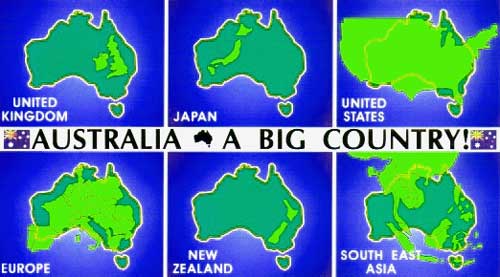
      Let’s take a look at data. If we compare Europe with the largest countries in the world, there are six (Russia, Canada, United States, China, Brazil and Australia) which are larger than our EU27, with a total area of just 4,324,782 km2. Russia, which is the largest country in our planet, is 4 times larger than Europe. The UE could perfectly fit within the island of Australia.
      There is a good exercise to better understand that our continent is not so large: just take a world map, cut out Chile (which ranks number 38, so it does not seem to be very large) and place it over Europe: one end is on the north of Sweden and the other end reaches… the Sahara desert!
      It goes without saying that size does not matter, though.

      Sources:
      1. Xenophanes of Colophon: http://en.wikipedia.org/wiki/Xenophanes
      2. The first world maps: http://www.henry-davis.com/MAPS/
      3. Article about map projection: http://en.wikipedia.org/wiki/Map_projection
      4. Graphical comparison between Peters and Mercator world maps: http://www.elpais.com/graficos/internacional/Representaciones/mapamundi/elpgraint/20100318elpepuint_1/Ges/
      5. Other possible projections: http://upload.wikimedia.org/wikipedia/commons/f/f8/Netzentwuerfe.png
      6. CIA’s estimates about the areas of countries: https://www.cia.gov/library/publications/the-world-factbook/rankorder/2147rank.html
      7. Graphical comparison between Australia and other countries: http://www.thekeenans.id.au/images/Australia-comparison.jpg


        Monday, September 13, 2010

        Drowning


        According to the WHO, every year 388,000 people drown in the world, including 175,000 children. Drowning outcomes mean those deaths caused by respiratory impairment from submersion/immersion in liquid, be it in the sea, in a river, in a swimming-pool or any other natural or artificial pool. As usual for high figures when counting people, money or stars, it is difficult to really understand what it stands for and it is necessary to compare it with other figures to have a clear idea of its magnitude. Let’s see an example: every year, the number of people drowned doubles the number of casualties in war (172,000 people).
        In most countries including Spain, drowning is the third leading cause of accidental death and the first in children under 5 years of age. For the moment, car accidents are still the first cause of mortality: 2,560 people were dead in road accidents in Spain in 2008, whereas 2,052 drowned.  However, road safety campaigns are effective and statistics can be different: in 2003, the number of people dead in road accidents (5,478) was five times greater than in 2008 in Spain. At this rate, we could get similar figures than in the Spanish region of Galicia, where drowning has become the first cause of mortality by accident.
        In order to account for such dropping figures, it is said that car accidents can be prevented, whereas drowning cannot because it is a natural, unavoidable phenomenon. However, statistics reveal that this argument does not add up: any person living in low- or middle-income countries has six times more chances to drown than any other person living in a high-income nation. Maybe drowning is not so natural...

        Sources:
        1. World Health Organization (WHO) webpage: http://www.who.int/en/index.html
        2. World Report on Child Injury Prevention 2008: http://whqlibdoc.who.int/publications/2008/9789241563574_eng.pdf
        3. World Health Report 2004: http://www.who.int/whr/2004/annex/topic/en/annex_2_en.pdf
        4. Spanish National Statistics Institute webpage: http://www.ine.es/en/welcome_en.htm
        5. Article in the Spanish newspaper El Faro de Vigo about fatalities in Galicia (in Spanish): http://www.farodevigo.es/galicia/2010/03/03/ahogamientos-son-principal-causa-muerte-accidental-galicia/416711.html


          Monday, September 6, 2010

          Tourism in Spain


          Although in 2009 the number of tourists visiting Spain dropped 8.7% in relation to the previous year due to the financial crises, figures are still very high: in 2009, Spain received 52.5 million tourists. And this is even more amazing if compared to Spanish demographics: in 2009, Spain had 45,989,016 inhabitants.
          The UNWTO (United Nations World Tourism Organization), a Madrid-based agency depending on the UN devoted to promoting tourism and drawing statistics, ranks Spain as the third most visited country in the world, just after France (74 million tourists) and the US (55 million tourists). The list goes on with China, Italy, United Kingdom, Turkey, Germany, Malaysia and Mexico, leading the ranking of the world’s ten major tourism destinations.
          Useful as this kind of reports may be as a source of tourism know-how, they only take into account the financial impact of tourism, leaving aside the social, cultural or ecological impact of the fact that, every year, one out of every 8 citizens in the world, that is, 880 million people decide to travel for sightseeing to another country.

          Sources:
          1. Data provided by the Spanish Ministry of Industry, Tourism and Trade in 2009: http://www.la-moncloa.es/NR/rdonlyres/2BC2EBB2-3E2C-4D50-96BC-F3B3E9D13BBB/101302/diego.pdf
          2. Population estimates by the Spanish National Statistics Institute: http://www.ine.es/jaxi/menu.do?type=pcaxis&path=%2Ft20%2Fp259&file=inebase&L=
          3. UNWTO (United Nations World Tourism Organization) web page: http://www.unwto.org/index.php
          4. UNWTO World Tourism Barometer 2009: http://www.unwto.org/facts/eng/pdf/barometer/UNWTO_Barom10_update_april_en_excerpt.pdf
          5.  

            Monday, August 30, 2010

            The perception of political corruption in the world

            No country is free from political corruption, but corruption is far from affecting all countries alike. Every year Transparency International, a Berlin-based NGO devoted to fighting political corruption and spreading information about it, draws a corruption perception index showing the corruption level perceived by businessmen and political analysts in their own countries. The ten most corrupted countries in the world include one from the Caribbean (Haiti), five from Central Asia and the Middle East (Iran, Turkmenistan, Uzbekistan, Iraq and Afghanistan), one from Southeast Asia (Myanmar) and three from Africa (Chad, Sudan and Somalia).
            Most countries of northern Europe come out on top as the less corrupted countries, but there are also some surprises: New Zealand ranks number 1 and Singapore ranks number 3.
            Within the European Union, Bulgaria, Greece and Romania are the three countries where corruption is perceived to be higher. In Denmark, Sweden and Switzerland, the perceived level of public corruption is the lowest. Spain ranks number 32 in the worldwide list, after such countries as Israel, Cyprus or Chile, and number 18 within the list of the 30 EU countries.

            Sources:
            1. http://www.transparency.org/
            2. Worldwide corruption perception index 2009 drawn by Transparency International: http://www.transparency.org/publications/publications/annual_reports/ti_ar2009
            3. EU corruption perception index 2009 drawn by Transparency International: http://www.transparencia.org.es/INDICE%20DE%20PERCEPCI%C3%93N%202009/Regiones.%20Union%20Europea%20y%20Europa%20del%20Oeste%5B1%5D.pdf

            Sunday, August 22, 2010

            How many countries are there in the world?


            In theory, it should be easy to count the countries in the world: an atlas or an encyclopaedia should be enough. However, many territories do not have a well-defined status or are not accepted by the international community as independent states. This is the case of Taiwan, an independent country since 1949 but not recognised as such by the UN and most countries because of the pressure exerted by the Chinese government, considering Taiwan just a rebel territory within Chinese borders.
            Not even the United Nations dares to count the countries in the world --in its web site, the FAQ “How many countries are there in the world?” is answered as follows:  “We are not an authority on this topic. We suggest you visit a public library in your area, consult an encyclopaedia or a world almanac”.
            And this is precisely what we did. There are 193 states with general international recognition: 192 member states of the United Nations plus the Vatican City, which is a UN permanent observer but not a member country.
            Besides these 193 states, there are several other countries, be them independent or not, which claim this status. The number of non-recognised countries depends on the author, but the most generous list accounts for 50 more countries, which added to the 193 internationally recognised countries, make up a total of 243.
            Out of these extra 50 countries, 9 or 10 are fully sovereign states which do not have general international recognition, including Taiwan (recognised only by 24 countries), the Turkish part of Cyprus (de facto independent state that is recognised only by Turkey), Palestinian territories in the Gaza Strip and in the West Bank (recognised by 92 countries), Kosovo (recognised by more than one third of UN members but not by Spain) and South Ossetia.
            Also, there are about 40 inhabited regions subject to other countries but in the process of becoming independent states, like Greenland and the Faroe Islands (belonging to Denmark) or with a status of its own, like some former colonies of European countries which are more or less autonomous regions still belonging to the metropolis. This list also includes some special cases like the Cook Islands, in free association with New Zealand, or the special administrative regions of Hong Kong and Macao, recognised by international treaties.
            Finally, there are many territories willing to become independent and it is possible that some of them manage to do so in the upcoming years, becoming part of this list.
            Therefore, it is not surprising that the UN washes its hands when counting the countries in this world.
             
            Sources:
             

            1. http://www.un.org/en/
            2. http://www.un.org/geninfo/faq/faq/faq.html